

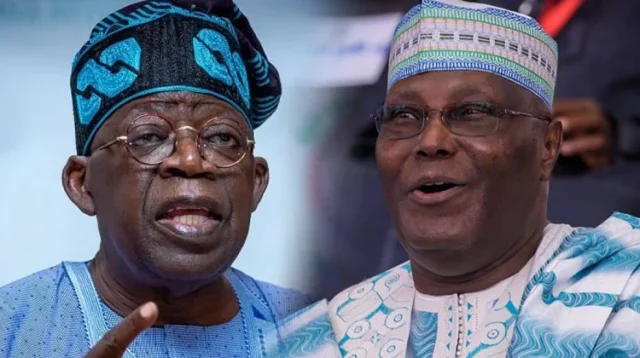
The Federal High Court in Abuja has granted the presidential candidate of the African Democratic Congress, Atiku Abubakar, permission to serve court documents on President Bola Tinubu through the All Progressives Congress, APC.
Justice Inyang Ekwo granted the request on Wednesday while ruling on an ex parte application filed by Atiku’s counsel, O.T. Omotayo-Ojo, seeking an order for substituted service.
Atiku and the ADC are asking the court to disqualify Tinubu and the APC from participating in the 2027 presidential election, over an allegation involving a forged National Youth Service Corps, NYSC, discharge certificate allegedly submitted to the Independent National Electoral Commission, INEC.
The suit, marked FHC/ABJ/CS/1888/2026, lists Tinubu, APC and INEC as the first, second and third defendants respectively.
The plaintiffs are also asking the court to direct INEC to remove Tinubu’s name and that of the APC from the list of candidates and political parties for the 2027 presidential election.
Court orders service within seven days
Moving the application on Wednesday, Omotayo-Ojo told the court that the plaintiffs had been unable to personally serve Tinubu with the originating summons and other court documents.
He therefore asked the court to allow the documents to be served on the President through the APC.
Justice Ekwo granted the application after Omotayo-Ojo, who appeared on behalf of Silas Onu, undertook that the plaintiffs would complete the service within seven days.
The judge subsequently adjourned the case until September 28 for mention.
At the previous hearing on September 1, Onu had informed the court that Tinubu had not yet been personally served with the originating summons and had requested permission for substituted service.
Tinubu and APC challenge suit
Meanwhile, Tinubu, the APC and INEC have filed separate responses challenging the competence of the case and asking the court to dismiss it.
In a joint counter-affidavit filed on September 9, Tinubu and the APC argued that the suit was incompetent and that Atiku and the ADC lacked the legal standing to institute the action.
The first and second defendants denied submitting any forged certificate to INEC for either the 2023 or 2027 presidential elections.
Through the APC Director of Legal Services, Sanusi Samaila, they also denied submitting Form CF001 to INEC for either election as alleged by the plaintiffs.
The defendants further stated that the NYSC had never denied issuing a discharge certificate to Tinubu after his service.
They maintained that no constitutional provision had been violated and that the submission of the President’s personal information to INEC had not caused any injustice to the plaintiffs.
Tinubu’s lawyers demand proof of forgery
In a written address accompanying their preliminary objection, counsel to Tinubu and the APC, Chief Akin Olujinmi, SAN, argued that the allegation of forgery was criminal in nature and therefore had to be established beyond reasonable doubt under Section 135(1) of the Evidence Act.
Olujinmi argued that a key requirement in establishing that a certificate was forged was evidence from the institution said to have issued it denying its authenticity.
He cited previous Supreme Court decisions, arguing that without a statement from the issuing institution disclaiming the document or confirming that part of it was not produced by the institution, an allegation of forgery could not be sustained.
The lawyer also argued that Atiku and the ADC had not presented evidence from the NYSC Directorate denying that it issued the discharge certificate attributed to Tinubu.
He consequently described the case as hypothetical and academic and lacking a real factual basis.
Olujinmi also argued that the suit was incompetent because it was a pre-election matter, and maintained that the plaintiffs lacked the legal standing to challenge Tinubu’s candidacy on the APC platform.
He urged the court to uphold the preliminary objection and dismiss the case.
INEC raises separate objections
INEC has also challenged the suit through a preliminary objection filed on September 7 by its counsel, Dr Alex Izinyon, SAN.
The electoral commission argued that the case was affected by issues including statute-bar, lack of locus standi, absence of a reasonable cause of action and abuse of court process.
INEC also alleged that the plaintiffs failed to meet the mandatory written deposition requirement under Paragraph 7(1) of the Federal High Court Pre-Election Practice Directions (Amendment) 2026.
The commission further challenged the propriety of Reliefs 2 and 3 in the originating summons and asked the court to dismiss the suit.
Source: PUNCH
