

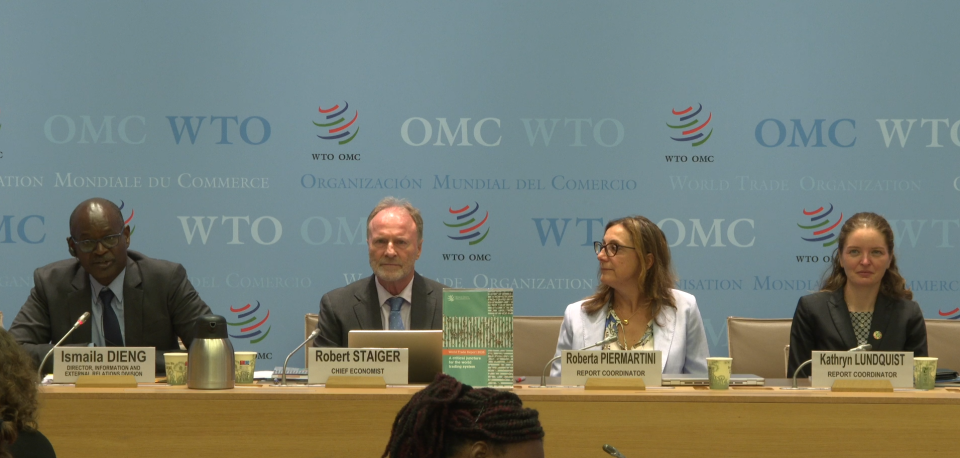
GENEVA — The World Trade Organization (WTO) has issued a stark warning regarding the future of the global economy, cautioning that escalating geopolitical tensions, surging subsidies, and trade fragmentation could cost the world economy up to 10% in real GDP compared to a future of strengthened multilateral cooperation.
Presenting the 2026 World Trade Report, titled “A Critical Juncture for the World Trading System,” WTO Chief Economist Robert Staiger emphasized that while the multilateral trading system remains resilient, it is under unprecedented strain.
“Many of the pressures confronting the multilateral trading system today are, in part, consequences of the system’s own success,” Staiger noted. “The challenge now is to adapt the system to the world economy it helped create.”
Key Takeaways from the 2026 Report
The High Cost of Inaction: Failing to reform the rules-based system could result in an economic loss equivalent to 10% of baseline global real GDP.
Four Pressures Straining Global Trade
The report identifies four major structural shifts that have outpaced the WTO’s existing framework:
– Changing Distribution of Economic Power: The rapid rise of developing economies has reshaped global trade, raising complex questions about reciprocal obligations, market access, and development flexibilities.
– Surging Government Intervention: A massive expansion in industrial policy and subsidies—paired with falling transparency—is making it harder to maintain fair market access commitments. Over 40% of mandatory subsidy notifications to the WTO are delayed or unfiled.
– Evolution of Trade Mechanics: Border tariffs are no longer the primary friction point. Modern trade is dominated by global supply chains, AI-driven digital services, and conflicting domestic regulation (such as privacy and environmental standards).
– Rise of Geopolitics & Security Concerns: Governments are increasingly viewing trade through a national security lens. Staiger warned that the expanding use of security rationales risks creating a cycle of trade restrictions and retaliation.
Economic Forecasts vs. Fragmentation Scenarios
WTO economic modeling comparing potential paths for global trade cooperation shows dramatic differences in long-term outcomes:
▪️ Enhanced Cooperation: Global GDP increases by +2.9% | Exports rise +17.9%
▪️ Geopolitical Fragmentation: Global GDP drops by -5.1% | Exports drop -18.6%
▪️ Bilateral/FTA-Only World: Global GDP drops by -6.9% | Exports drop -26.9%
Developing Economies Have the Most at Stake
While trade fragmentation threatens global growth across the board, the WTO report stresses that smaller and lower-income economies will bear the brunt of any shift away from common multilateral rules toward power-based bilateral bargaining.
According to WTO projections running through 2050, Least-Developed Countries (LDCs) could see up to 25% of their GDP at stake in a worst-case fragmentation scenario, compared to the global average of roughly 10%.
Adaptation, Not Abandonment
Rather than prescribing a rigid, top-down reform blueprint, the report provides an economic diagnosis to help the WTO’s 166 member states negotiate necessary updates.
Staiger emphasized that the goal is not to preserve the system unchanged, nor to declare its founding principles obsolete, but to introduce flexible, pragmatic rules that can manage modern realities.
“The system continues to deliver substantial benefits, including an estimated 140% boost to trade between members,” Staiger said. “Reforming the global trading system will be difficult, but it remains necessary to protect the gains of decades of trade integration.”
Declining MFN Dominance: Roughly 72% of global merchandise trade still operates under Most-Favoured-Nation (MFN) tariff terms—down from 80% just two years ago.
Empowered Developing Nations: Low- and middle-income economies accounted for 45% of global trade in 2024, up from 23% in 1995.
The Digital Boom: Digitally delivered services now make up 55% of all global service exports, reflecting a structural shift toward “behind-the-border” trade policies.
