
Several state governments are imposing billboard and poster fees running into tens or hundreds of millions of naira on presidential candidates, raising concerns that the cost of campaign visibility could disadvantage opposition parties ahead of the January 16, 2027 election.
Campaigns for the presidential and National Assembly elections began on August 19, by which time several states had already published their advertising fee schedules. The Independent National Electoral Commission (INEC) had cleared 19 presidential candidates.
Abia State reportedly has the highest charges, with its signage agency demanding N200 million from presidential candidates, N150 million from governorship candidates, N100 million from senatorial candidates, N50 million from House of Representatives candidates and N20 million from State Assembly candidates.
Enugu and Kogi states each charge presidential candidates N150 million, while the reported rates are N150 million in Cross River, N75 million in Rivers and N50 million in Anambra. The Anambra figure represents a fivefold increase from the N10 million presidential billboard fee reported in 2022.
Other states have adopted different approaches. Kano charges approximately N1.15 million without distinguishing between political and commercial billboards, while Kaduna determines fees according to individual locations. In Imo, senatorial candidates are required to pay N5 million, in addition to application and inspection charges.
Billboard fees and campaign spending limits
The charges have attracted attention because the Electoral Act 2026 places a N10 billion ceiling on presidential election expenses and a N3 billion limit on governorship campaign spending.
If the N200 million presidential billboard fee in Abia were applied across all 36 states and the Federal Capital Territory, candidates would face a combined cost of N7.4 billion for permits alone. That would represent 74 per cent of the presidential spending limit before accounting for rallies, jingles, transportation and other campaign activities.
The Allied Peoples Movement (APM) and its presidential candidate, Oyo State Governor Seyi Makinde, have argued that billboard charges could consume more than 80 per cent of the spending ceiling.
They have filed suit HC/214/2026 at the Abia State High Court, seeking a declaration that the N200 million charge is unconstitutional and invalid. At the time of the report, no hearing date had been announced, and no court had ruled on the legality of the fees.
Opposition parties question the charges
The African Democratic Congress (ADC) has described the charges as an attempt to restrict opposition campaigns and said it would challenge them. The Nigeria Democratic Congress (NDC) has also criticised the fees, noting that many of the affected states are controlled by the All Progressives Congress (APC).
However, the political picture is not uniform. The N200 million charge in Abia was introduced under Governor Alex Otti of the Labour Party. In Oyo, the APC has accused the APM-led state government of instructing its signage agency to restrict campaign activities by candidates outside the party.
Enugu and Kogi, both governed by the APC, are also among the states facing opposition complaints.
The different political affiliations of the governments involved complicate claims that the charges represent a coordinated strategy by one party. However, critics argue that the situation highlights the broader influence incumbent administrations exercise over access to outdoor advertising space.
State governments defend billboard charges
The affected governments maintain that their fees are administrative measures rather than attempts to obstruct political campaigns.
Abia State has said its tariff applies equally to all political parties and candidates, insisting that it will not discriminate against any contender.
Kogi State Commissioner for Information Kingsley Fanwo similarly argued that the rules apply to APC candidates and other parties alike, adding that the government serves everyone.
The states have cited their authority over physical planning and urban aesthetics. Abia also pointed to a billboard collapse in Aba in 2025 as one factor informing its approach.
The Enugu APC has said it is paying the applicable charges itself.
Political scientist Professor Kamilu Sani Fage of Bayero University, Kano, however, questioned whether the fees would affect all parties equally. He argued that ruling parties might be able to draw on public resources while opposition candidates would have to pay from their own funds.
Opposition parties in Abia, including the ADC and the Peoples Democratic Party (PDP), have also questioned whether state signage agencies possess the legal authority to impose the charges.
Fage criticised the timing of the measures, arguing that introducing such fees during the campaign period was inappropriate.
The Out-of-Home Advertising Association of Nigeria has called on state governments to comply with officially gazetted tariffs. Meanwhile, the Advertising Regulatory Council of Nigeria (ARCON) has stated that state agencies do not have the authority to approve political advertisements before their display.
Legal questions over political advertising
Constitutional lawyer Kehinde Oloje said the Electoral Act does not specifically regulate billboard placement, leaving the matter to state and local legislation.
Opponents of the charges argue that the restrictions could conflict with provisions prohibiting the use of state institutions to favour or disadvantage electoral candidates. They have also raised concerns about the constitutional protections for freedom of expression and association under Sections 39 and 40.
State authorities, meanwhile, rely on their powers under the Land Use Act, although questions remain about whether outdoor advertising fees should be collected by local governments.
Early impact on campaign visibility
The effects are reportedly becoming evident in some states. In Lagos, where signage fees are not specifically designed for political campaigns, many opposition candidates had yet to put up billboards after campaigns opened.
In Imo, the Action People’s Party (APP) says it is paying the charges despite their high cost.
Abia APC governorship candidate Eric Opah has indicated that he intends to rely on ordinary residents, including workers, pensioners and traders, as campaign billboards rather than paid advertising spaces.
Billboards remain attractive to politicians because they can reach large audiences repeatedly over an extended period. Candidates unable to afford them may have to rely more heavily on radio, social media and town-hall meetings.
Calls for intervention
Stakeholders have urged INEC to provide guidelines clarifying the relationship between administrative advertising fees and campaign expenditure.
They have also called on the National Assembly to establish limits on state charges for political advertising and asked governments to publish information showing which candidates have paid the fees and whether any exemptions have been granted.
The stakeholders further want the courts to resolve the legal disputes early enough to provide certainty before the elections.
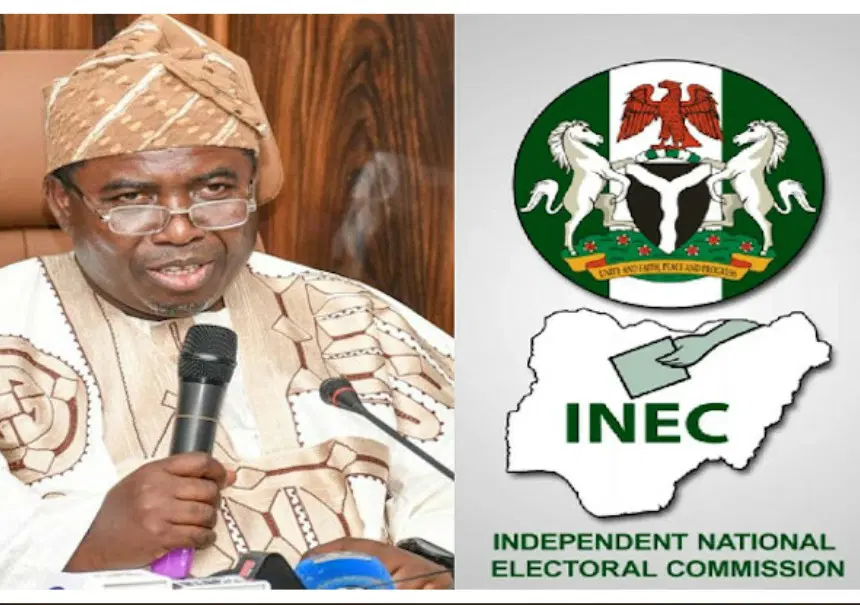
INEC Chairman Professor Joash Amupitan, SAN, has said the commission will monitor illegal campaign spending and that broadcasters must provide equal access to all political parties.
Source: Vanguard
