

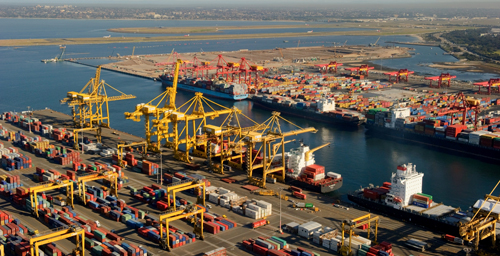
Nigeria imported goods worth N11.01 trillion from China in the first half of 2026, accounting for 39.27 per cent of the country’s total imports during the period.
The figures are contained in the latest Foreign Trade in Goods Statistics released by the National Bureau of Statistics, NBS, and analysed by The PUNCH.
According to the data, Nigeria’s imports from China increased from N5.10 trillion in the first quarter to N5.92 trillion in the second quarter.
The combined figure represented nearly four out of every 10 naira spent on imported goods between January and June 2026, when Nigeria’s total import bill stood at N28.04 trillion.
China’s Share of Imports Rises
Nigeria imported N9.62 trillion worth of goods from China in the first half of 2025, comprising N4.66 trillion in the first quarter and N4.96 trillion in the second.
Imports from China therefore increased by N1.39 trillion, or 14.49 per cent, in the first half of 2026.
This happened even though Nigeria’s overall import bill declined.
Total imports fell from N33.14 trillion in H1 2025 to N28.04 trillion in H1 2026, representing a 15.37 per cent decline.
As a result, China’s share of Nigeria’s imports increased from 29.03 per cent in H1 2025 to 39.27 per cent in H1 2026.
China remained Nigeria’s largest source of imported goods in both quarters.
In Q1 2026, China supplied N5.10 trillion, representing 37.42 per cent of Nigeria’s N13.62 trillion total imports.
The United States ranked second with N2.81 trillion, while India supplied N992.87 billion.
In Q2, imports from China rose by 16.09 per cent quarter-on-quarter to N5.92 trillion, accounting for 41.02 per cent of Nigeria’s N14.42 trillion total imports.
By comparison, the United States supplied N1.01 trillion, or 6.97 per cent, while India accounted for N924.46 billion, or 6.41 per cent.
The Netherlands and Germany supplied N409.81 billion and N395.87 billion respectively.
Concerns Over Counterfeit Products
The growing volume of Chinese imports comes amid renewed concerns over the circulation of counterfeit and substandard goods in Nigeria.
The National Agency for Food and Drug Administration and Control, NAFDAC, has raised concerns about what it described as a new pattern involving some Chinese-linked counterfeit networks operating within Nigeria.
NAFDAC’s Director of Investigation and Enforcement, Martins Iluyomade, said investigations indicated that some operators identify popular products in the Nigerian market, arrange for them to be replicated and then use logistics networks to distribute the counterfeit goods.
He said this represented a change from the previous practice in which Nigerian counterfeiters travelled to China to arrange the production of fake goods.
Iluyomade said some of the operators were allegedly linked to logistics companies used to bring counterfeit products into Nigeria.
NAFDAC has consequently been shutting down logistics companies allegedly connected to such distribution networks.
However, the agency’s allegations do not mean that the N11.01 trillion worth of goods imported from China were counterfeit.
Rather, the size of the trade highlights the scale of the supply chain that requires regulatory monitoring both at Nigeria’s borders and within the domestic market.
China Dominates Nigeria’s Asian Imports
China’s dominance is even more pronounced in Nigeria’s trade with Asia.
Nigeria imported N16.12 trillion worth of goods from Asia in the first half of 2026, with China accounting for N11.01 trillion, or 68.34 per cent.
Asia supplied 55.45 per cent of Nigeria’s imports in Q1, with its share increasing to 59.37 per cent in Q2.
The Chinese imports cover several important areas of the Nigerian economy.
In Q1, major imports from China included machines used for the reception, conversion and transmission of voice, images or data, valued at N254.41 billion.
Other major products included seeders, planters and transplanters worth N137.94 billion, parts of communication equipment valued at N104.53 billion, herbicides and related agricultural products worth N103.83 billion, and line pipes used for oil and gas pipelines valued at N81.15 billion.
In Q2, major Chinese imports included photovoltaic cells assembled into modules or panels worth N184.02 billion.
Nigeria also imported N158.73 billion worth of communication equipment, N152.56 billion of machinery with a 360-degree revolving superstructure, N128.88 billion of herbicides and related products, and N126.45 billion of machinery for cleaning, sorting or grading seeds and grains.
The figures show China’s importance to sectors including telecommunications, agriculture, construction, renewable energy and manufacturing.
Manufactured Goods Imports Increase
The rising dependence on imported goods from China coincided with an increase in Nigeria’s manufactured goods imports.
Manufactured goods imports stood at N8.48 trillion in Q1 2026, representing a 12.94 per cent increase from N7.51 trillion recorded in Q1 2025.
The figure rose to N9.51 trillion in Q2, up 20.65 per cent from N7.88 trillion a year earlier and 12.10 per cent higher than Q1.
Nigeria therefore imported about N18 trillion worth of manufactured goods in H1 2026, representing 64.16 per cent of total imports.
Nigeria Records N9.92tn Trade Deficit With China
The trade figures also reveal a significant imbalance between Nigeria’s imports from and exports to China.
Nigeria exported goods worth N582.20 billion to China in Q1 and N506.57 billion in Q2, bringing total exports to China to N1.09 trillion in the first half of the year.
With imports from China standing at N11.01 trillion, Nigeria recorded an estimated N9.92 trillion merchandise trade deficit with the country during the six-month period.
This means that for every N1 worth of goods Nigeria exported to China, it imported approximately N10.11 worth of goods.
Nigeria’s exports to China represented only about 2.26 per cent of its N48.19 trillion total exports during the period.
NAFDAC Intensifies Enforcement
NAFDAC has continued to strengthen its campaign against counterfeit and substandard products, particularly fake medicines, food products, cosmetics and other regulated goods.
The agency said it secured 64 convictions for counterfeiting offences between June 2025 and June 2026.
NAFDAC Director-General, Professor Mojisola Adeyeye, also disclosed that the agency had seized or destroyed more than N1.54 trillion worth of fake and substandard regulated products nationwide since 2023.
Operators in the organised private sector have also warned that counterfeiting is damaging legitimate businesses by reducing sales, discouraging investment and threatening jobs.
Vice Chairman of the Lagos Chapter of the National Association of Small-Scale Industrialists, Peter Popoola, said counterfeit goods reduce the revenue of legitimate manufacturers and can damage their reputation when consumers mistake fake products for genuine ones.
He said small businesses often lack the financial resources required to protect their brands or pursue legal action against counterfeiters.
Popoola called for government-backed grants and low-interest loans to help genuine manufacturers expand, alongside consumer credit schemes that could make quality products more affordable.
The Chief Executive Officer of Spectra Industries Limited, Duro Kuteyi, similarly attributed the growing demand for counterfeit goods partly to declining household incomes.
He said consumers with limited purchasing power were increasingly looking for cheaper alternatives, creating opportunities for counterfeiters.
Source: PUNCH
