

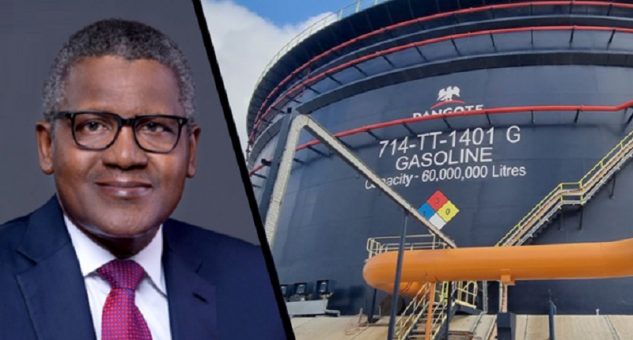
The Federal Government has described the Dangote Petroleum Refinery and Petrochemicals as a major pillar of Nigeria’s plan to build a $1 trillion economy, promising stronger collaboration with the private sector to drive industrialisation, job creation and economic transformation.
The Minister of State for Industry, Senator John Owan Enoh, stated this after leading a high-level delegation from the ministry on a tour of the 700,000 barrels-per-day Dangote Petroleum Refinery, the petrochemicals complex and Dangote Fertiliser Limited in Lagos.
Enoh said the integrated facility is one of the largest industrial investments in Africa and represents the type of large-scale manufacturing needed to achieve Nigeria’s economic growth ambitions.
According to him, the visit highlighted the importance of manufacturing to the implementation of the Nigeria Industrial Policy, unveiled earlier in 2026.
He said the refinery is not just an industrial project but a symbol of value addition, competitiveness and the country’s expanding manufacturing capacity.
The minister added that the project has helped change international perceptions of Nigeria by supporting the country’s transition from a major importer of refined petroleum products to an exporter supplying foreign markets.
He noted that during periods of global supply disruption, Nigeria was able to export petroleum products to markets in the Middle East and other regions, describing this as a significant achievement.
Enoh, who was accompanied by directors, regulators and heads of agencies under the ministry, said the delegation gained a better understanding of the scale, technology and strategic importance of the facilities.
He also dismissed concerns about the refinery’s single-train configuration, saying operations continued even during scheduled maintenance activities.
The minister pledged that the ministry and its agencies would continue to support the refinery and the wider industrialisation agenda through platforms such as the Industrial Revolution Work Group and ministerial roundtables.
He said government would also work to address challenges facing manufacturers, particularly access to affordable long-term financing.
Enoh commended Aliko Dangote for supporting the launch of the Nigeria Industrial Policy and said partnerships with industry leaders would be essential to achieving the policy’s targets of raising manufacturing’s contribution to GDP to about 20 percent by 2030 and 25 percent by 2035.
Speaking during the visit, Dangote urged the Federal Government to place industrialisation at the center of its economic strategy, arguing that no country has achieved prosperity without a strong manufacturing base.
He said local investors are often the strongest signal to foreign investors that an economy is attractive for investment.
Dangote disclosed that Dangote Industries recently raised an unsecured and unrated bond at rates below Nigeria’s sovereign benchmark, which he said reflected growing investor confidence in credible Nigerian private-sector institutions.
According to him, the successful fundraising showed that Nigerian companies can attract long-term capital when government policies are stable and predictable.
He also praised Senator Enoh’s commitment to industrial development, saying the ministry would play an important role in attracting investment, creating jobs and advancing President Bola Tinubu’s $1 trillion economy agenda.
Dangote stressed that policy consistency is more important to investors than incentives, warning that frequent policy reversals undermine confidence.
Reflecting on the refinery project, he described it as the biggest business risk of his life, recalling that many financiers doubted it would be completed.
Despite challenges such as the COVID-19 pandemic, foreign exchange volatility and lender skepticism, he said the successful completion of the refinery demonstrated the ability of Nigerian entrepreneurs to deliver projects of global scale.
He added that at full capacity, the refinery would account for the equivalent of about 10 percent of the United States’ refining capacity and consume approximately 2.5 percent of globally traded crude oil.
Dangote urged continued support for indigenous investors, describing them as critical to employment creation, foreign exchange earnings and Nigeria’s long-term economic resilience.
