

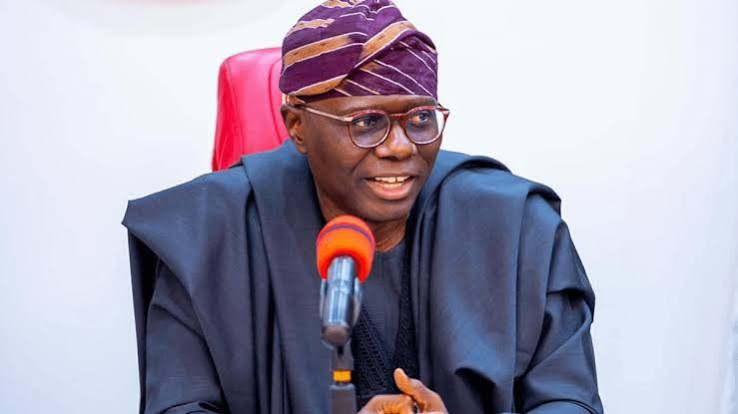
Lagos State Governor, Babajide Sanwo-Olu, has reiterated his administration’s commitment to strengthening the state’s manufacturing capacity, attracting productive investments and expanding exports through the implementation of the Lagos State Industrial Policy 2025–2030.
The governor said the policy was designed to establish a more competitive, inclusive and sustainable industrial economy by aligning infrastructure development, industrial financing, priority sectors, business clusters and workforce development.
Sanwo-Olu stated this on Friday in his address delivered by the Commissioner for Commerce, Cooperatives, Trade and Investment at the opening ceremony of the 40th Lagos International Trade Fair, held at Tafawa Balewa Square, Lagos.
He said Lagos was building on its established position as a centre of trade and services to strengthen its role in production, innovation, investment and exports.
“Our ambition for Lagos is clear. We want more businesses to manufacture, process and add value here; to establish regional operations here; and to use Lagos as a gateway to markets across West Africa and the continent,” the governor said.
Sanwo-Olu described the 40th edition of the Lagos International Trade Fair as an important milestone in the commercial history of Lagos and Nigeria, commending the Lagos Chamber of Commerce and Industry (LCCI) for sustaining the platform over the past four decades despite changing economic conditions.
He, however, stressed the need for trade fairs to evolve beyond product exhibitions and become platforms for meaningful business transactions, investment opportunities and sustainable commercial relationships.
“This 40th edition is especially significant because the fair is expanding its role. Its stronger focus on business-to-business and business-to-government engagement recognises that a trade fair must do more than display products.
“It should help companies secure buyers, attract investment, strengthen supply chains and create opportunities that endure beyond the event,” he said.
The governor noted that with more than 1,000 exhibitors expected from over 20 countries, alongside a dedicated Africa Hall showcasing opportunities under the African Continental Free Trade Area (AfCFTA), the fair reflected Lagos’s growing importance as a meeting point for African and international commerce.
He described the AfCFTA’s market of 1.4 billion people as a significant opportunity for businesses capable of meeting standards, producing at scale and delivering competitively.
According to him, Lagos is positioning itself to attract more businesses interested in establishing manufacturing operations, processing raw materials and developing regional markets.
Sanwo-Olu said the state’s infrastructure investments and efforts to improve the business environment were central to achieving this objective.
He identified the Blue and Red Rail Lines, alongside ongoing investments in roads and transport networks, as important interventions strengthening connections across commercial and industrial corridors.
“Efficient movement of people and goods reduces business costs, supports productivity and helps enterprises compete,” he said.
On the importance of energy and digital infrastructure to business growth, the governor said the Lagos State Electricity Law had provided a framework for developing a more reliable and competitive electricity market.
He added that investments in digital infrastructure were expanding the connectivity required by modern enterprises, while engagements with private-sector operators were helping the government identify bottlenecks and make its processes more responsive and transparent.
The governor also highlighted Lagos’s performance in the 2025 Presidential Enabling Business Environment Council (PEBEC) Subnational Ease of Doing Business Report, where the state ranked first nationally with a score of 85.6 per cent.
He described the ranking as an encouragement for his administration to sustain efforts towards creating a business-friendly environment, while acknowledging the challenges confronting enterprises.
“This recognition encourages us to keep improving. Businesses continue to face pressures around energy, finance, logistics and other operating costs; our work is to address these constraints and build an environment in which enterprises can grow, invest and create jobs,” he said.
On industrial development, Sanwo-Olu explained that the Lagos State Industrial Policy 2025–2030 provided a practical framework for strengthening the state’s productive capacity.
He said the policy connected infrastructure and an improved business environment with industrial finance, priority sectors and clusters, stronger small businesses and cooperatives, as well as the skills and sustainability required for modern production.
Emphasising the importance of manufacturing to economic development, the governor said the sector had the capacity to generate value across the economy by transforming ideas and raw materials into finished products, supporting local suppliers and creating skilled employment.
“This policy matters because manufacturing creates value across the economy. It turns ideas and raw materials into finished goods, supports local suppliers, creates skilled employment and gives businesses products they can sell beyond Lagos,” he said.
He added that aligning infrastructure, finance, industrial clusters and workforce development would help manufacturers expand production and position Lagos as a stronger base for regional trade.
On export development, the governor disclosed that the Lagos State Export Readiness Programme (LASERP), implemented in partnership with the African Export-Import Bank (Afreximbank) and ImpactHer, had supported 253 small and medium-sized enterprises (SMEs) in preparing to access international markets.
According to him, the programme was helping businesses understand and meet export requirements, particularly in product standards, packaging, financing and other critical areas.
He further disclosed that 20 Trade Champions had helped showcase Made-in-Lagos products at the Intra-African Trade Fair.
“These are practical steps towards helping local businesses translate quality products into export orders, revenue and jobs,” Sanwo-Olu said.
The governor expressed particular interest in the opportunities the trade fair could create for micro, small and medium-sized enterprises (MSMEs), noting that many local businesses had the creativity, products and determination to compete but lacked access to critical resources.
He identified finance, technology, dependable commercial networks and access to larger buyers as some of the requirements needed to help smaller businesses expand.
Sanwo-Olu urged exhibitors to maximise the business-to-business and business-to-government platforms provided by the fair to establish partnerships that would translate into actual transactions and sustained growth.
“I am particularly interested in what this fair can achieve for our micro, small and medium-sized enterprises (MSMEs). Many have the creativity, products and determination to compete, but need access to finance, technology, dependable commercial networks and larger buyers.
“The business-to-business and business-to-government platforms at this fair can help bridge that gap. I encourage exhibitors to use them to build relationships that lead to real transactions and sustained growth,” he said.
He also called on international exhibitors and investors to consider long-term investment opportunities in Lagos rather than focusing solely on selling their products in the Nigerian market.
He urged them to explore local manufacturing, technology transfer, supplier development and partnerships with Nigerian businesses, particularly in manufacturing, agro-processing, logistics, technology and other productive sectors.
Addressing local exhibitors, especially young entrepreneurs, the governor encouraged them to use the trade fair to connect with prospective partners, understand market demands and learn from businesses operating in other markets.
He maintained that the impact of the annual event should be measured by the economic opportunities and lasting relationships it generates rather than attendance figures alone.
“The success of this fair will be measured not only by attendance, but by the deals, investments, jobs and lasting commercial relationships it helps create,” he said.
Looking ahead, Sanwo-Olu said he wanted the Lagos International Trade Fair to become a stronger platform for African producers, productive investments and Nigerian businesses seeking to compete in regional and international markets.
He congratulated the LCCI leadership, exhibitors, sponsors and partners on the 40th edition of the fair, wishing participants productive engagements and successful business transactions.
The governor subsequently declared the 40th Lagos International Trade Fair open.
