

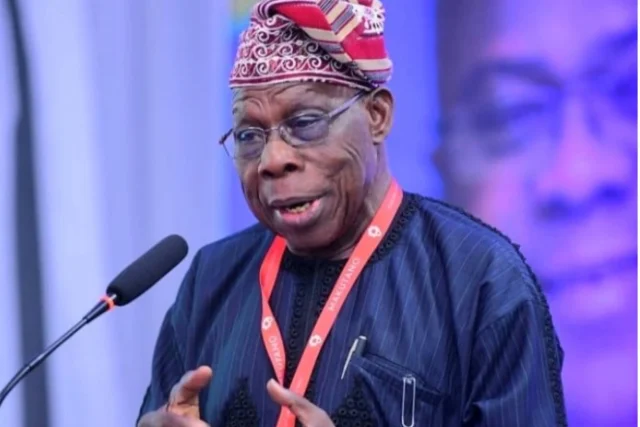
Former President Olusegun Obasanjo has supported calls for an increase in the 13 per cent derivation allocation to oil-producing states, describing the existing percentage as a starting point for further discussions.
Obasanjo spoke on Monday during the flag-off of the Crude Distillation Unit of the $1bn Azikel Refinery in Obunagha, Yenagoa Local Government Area of Bayelsa State. He also challenged the refinery’s promoter to complete the facility within 12 months.
Addressing Bayelsa State Governor Douye Diri, the former President agreed that oil-producing states and communities had not received a fair share of the benefits from resources extracted from their territories.
He said the 13 per cent derivation allocation should not be considered the final position, encouraging the affected states to continue engaging the relevant authorities on the matter.
Obasanjo’s comments followed renewed criticism by Diri of the derivation formula and the Land Use Act, which the governor said had disadvantaged communities in the Niger Delta.
The Azikel Refinery, owned by Azikel Petroleum under the Azikel Group, is designed to process 25,000 barrels of crude oil daily.
Obasanjo laid the foundation for the project about eight years ago. The installation of the crude distillation unit represents a significant milestone in its development.
He commended the President of Azikel Group, Azibapu Eruani, for keeping the project alive and urged him to ensure its completion within the next year. Obasanjo, who said he would officially turn 90 next March, expressed a desire to see the refinery completed before then.
He also acknowledged the contributions of the African Finance Corporation and the African Export-Import Bank, calling for continued support to bring the investment to completion.
The former President further praised Governor Diri for what he described as the effective use of Bayelsa’s revenue, pointing to development projects across the state.
He said the state government had made productive use of the funds available to it, despite what he described as the limited resources received.
In his remarks, Diri said the refinery offered residents of Bayelsa and the wider Niger Delta an opportunity to participate more directly in the petroleum industry, rather than remain mainly suppliers of crude oil.
The governor said communities in the region had long complained about the imbalance between the locations where oil is extracted and the areas that benefit from its exploitation.
He argued that the Ijaw people had continued to demand greater benefits from the natural resources found in their communities, expressing concern that residents felt excluded from the wealth generated by the industry.
Diri also criticised the Land Use Act, arguing that the distinction between state control of surface resources and Federal Government control of resources beneath the ground placed oil-producing communities at a disadvantage.
He maintained that the Niger Delta was not seeking to take all the proceeds from its natural resources but wanted a greater role in decisions concerning their management. He reiterated that the 13 per cent derivation allocation was inadequate.
The governor called on young people in Bayelsa to develop the skills needed to secure jobs and business opportunities from the refinery and other industrial investments. He warned that local communities might not fully benefit from the projects without the necessary technical and professional expertise.
Diri also appealed to oil companies operating around Gbarain and Obunagha to repair the road leading to the refinery, urging them to support the state government’s efforts to facilitate the project.
He further advocated local processing of Africa’s natural resources, saying the continent needed to retain more industrial and economic value by refining and processing its resources domestically.
Speaking at the event, Eruani said the refinery was established to make Bayelsa and the Niger Delta active participants in the petroleum industry.
He described the installation of the crude distillation unit as the beginning of the facility’s completion phase and said the project would support industrial development in the state and the wider region.
According to the project’s promoters, the refinery is expected to produce 2.5 million litres of petrol and two million litres of diesel daily, alongside other petroleum products.
Eruani also praised President Bola Tinubu for supporting indigenous refineries, saying their development aligned with the Federal Government’s goal of improving the availability and affordability of petroleum products.
A board member of Azikel Petroleum, Daru Owei, and the Ibenanaowei of Ekpetiama Kingdom and Chairman of the Bayelsa State Council of Traditional Rulers, King Bubaraye Dakolo, also commended Eruani.
They expressed optimism that the refinery would contribute to the economic development of Bayelsa State, the Niger Delta and Nigeria as a whole.
Source: PUNCH
