

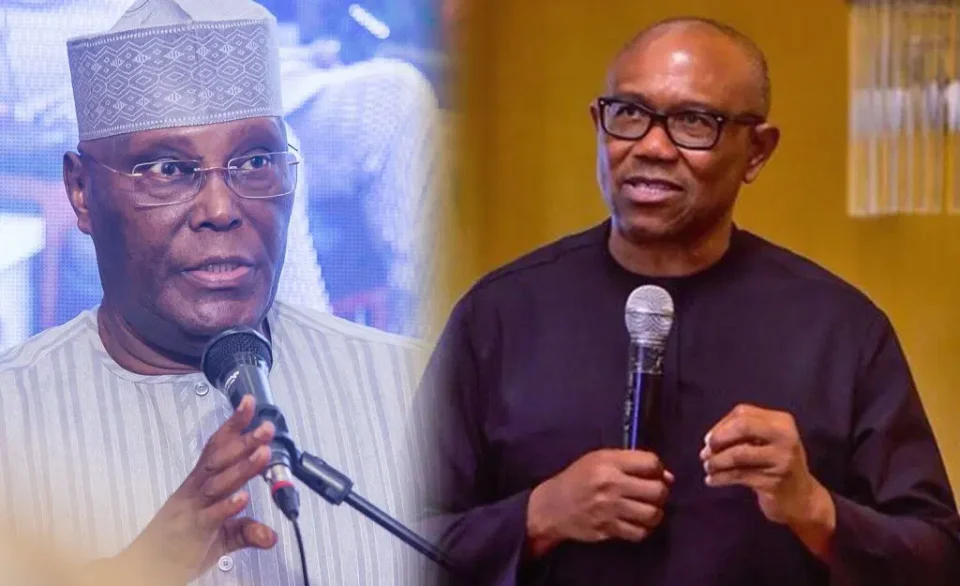
Presidential candidate of the Nigerian Democratic Congress (NDC), Peter Obi, has disagreed with African Democratic Congress (ADC) candidate, Atiku Abubakar, over the proposal to restore fuel subsidy if elected president in 2027.
Obi spoke during a panel session at the Nigerian Bar Association (NBA) conference in Port Harcourt, Rivers State, where opposition presidential candidates debated the country’s security challenges, economy, policing system and fuel subsidy policy.
Atiku, who supported the removal of petrol subsidy during the 2023 presidential election, has said he would reverse the policy if elected in 2027.
Obi, however, maintained that subsidy removal was necessary, arguing that the major problem was the poor management of the funds saved from the policy.
The former Anambra State governor said the resources recovered from subsidy removal should have been redirected into programmes that would ease the impact of the policy on Nigerians.
He argued that mismanagement and alleged diversion of the savings should not be used as an excuse to restore subsidy.
Obi said he had already outlined his position on subsidy removal in his manifesto ahead of the 2023 election, promising that the process would be properly structured and that the savings would be invested appropriately.
President Bola Tinubu announced the removal of petrol subsidy on his inauguration day in May 2023. The decision resulted in a significant increase in petrol prices and contributed to growing concerns about the cost of living.
Amaechi, Sowore and others offer different solutions
Other opposition presidential candidates also presented contrasting positions on the country’s challenges during the NBA conference.
Former Rivers State governor and ADC vice-presidential candidate, Rotimi Amaechi, said Nigeria’s economy could be stabilised through large-scale job creation, increased local production and policies designed to improve citizens’ purchasing power.
Amaechi highlighted projects from his tenure as Rivers governor, saying his administration constructed more than 500 primary schools, over 300 health centres and more than 200 roads. He also said intelligence-led operations helped reduce crime in the state.
He promised that an Atiku-Amaechi administration would ensure a fair distribution of political appointments across the country, accusing the Tinubu administration of concentrating appointments in certain areas.
Meanwhile, African Action Congress (AAC) presidential candidate, Omoyele Sowore, called for a change of government, arguing that the current administration had failed to adequately address Nigeria’s security problems.
Sowore also maintained his long-standing opposition to the way fuel subsidy had been implemented, arguing that the policy primarily benefited wealthy Nigerians and governors rather than ordinary citizens.
He said the key question should be who actually benefited from the subsidy system.
On security, Sowore and Social Democratic Party (SDP) presidential candidate, Adewale Adebayo, said a change of leadership was necessary to effectively tackle terrorism and other security threats.
Adebayo, however, proposed a different approach to policing. He advocated a three-level structure comprising federal, state and local government police.
Former Cross River State governor, Donald Duke, identified leadership as the country’s major challenge, arguing that improvements in other sectors would follow if Nigeria got its leadership right.
Duke also criticised the growing influence of ethnicity in Nigerian politics and called for reforms to strengthen the presidential system.
Gbajabiamila defends state police proposal
Earlier, the Chief of Staff to President Tinubu, Femi Gbajabiamila, defended the Federal Government’s proposed state police reform.
Speaking in a keynote address titled “Policing in Transition,” Gbajabiamila said the Tinubu administration had taken on an issue that previous governments had avoided.
He explained that the move was intended to address weaknesses associated with Nigeria’s highly centralised policing structure.
Gbajabiamila warned that decentralised policing without adequate safeguards could create additional problems, saying the proposed framework was designed to combine federal and state policing while addressing existing shortcomings.
He also acknowledged concerns that governors could misuse state police against political opponents, asking who would be responsible for policing the police.
According to him, Nigeria currently has approximately one police officer for every 650 people, compared with an international benchmark of one officer for every 450 people.
He said the shortage was further aggravated by the deployment of officers to administrative duties and personal security escorts instead of core policing responsibilities.
Gbajabiamila stressed the importance of training, professionalism and strong institutional safeguards, arguing that policing should become an attractive and respected profession capable of drawing qualified Nigerians.
He agreed that governors, as elected chief executives, should have executive authority but maintained that they must not be permitted to use the police to order the arrest of political opponents.
He also advocated protection for police officers who refuse to carry out unlawful orders, saying such safeguards must be supported by strong institutions.
The NBA conference has emerged as one of the major early platforms where 2027 presidential contenders have publicly presented their positions on security, economic management, policing and governance, signalling a potentially competitive political contest ahead of the general elections.
