

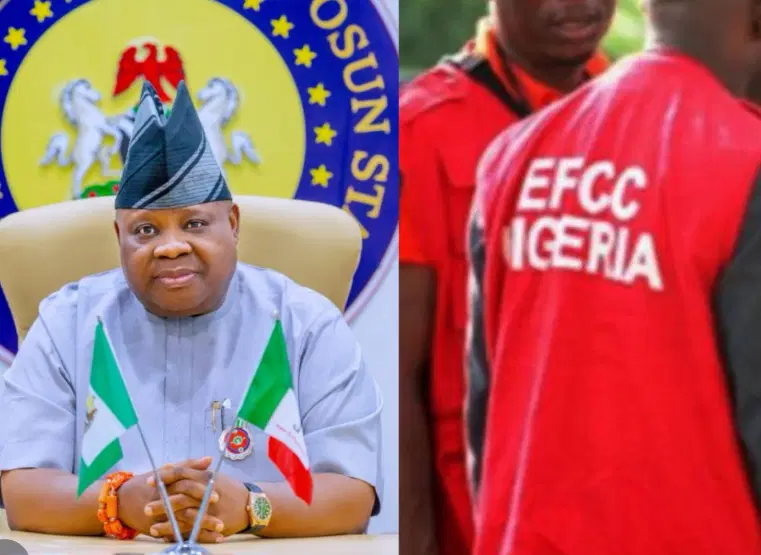
The alleged freezing of an Osun State Government account by the Economic and Financial Crimes Commission (EFCC) has sparked strong reactions from Governor Ademola Adeleke, opposition parties and legal practitioners, coming just days before the August 15, 2026 governorship election.
According to a letter dated August 5, 2026, the EFCC directed a first-generation bank to place a post-no-debit restriction on account number 2017170947. The letter, signed by the commission’s Director of Investigation, Adenike Babalola, cited Section 38(1) and (2) of the EFCC Act 2004 and Section 24 of the Money Laundering Prevention and Prohibition Act.
Addressing journalists in Osogbo, Governor Adeleke questioned the legal basis for the action and described it as a violation of due process. He said he had instructed the state Attorney-General and Commissioner for Justice to challenge the move at the Federal High Court in Osogbo.
Osun State Attorney-General Oluwole Jimi-Bada (SAN) argued that the EFCC does not have the constitutional power to freeze a state’s statutory account. He said the funds in the account are meant for salaries, pensions, healthcare, education, security and other essential government obligations, and that any restriction should be determined by a competent court.
EFCC says action linked to N11bn investigation
Responding to the controversy, EFCC spokesperson Dele Oyewale said the commission had been investigating the Osun State Government since March 2026 over the alleged handling of Ecology Funds, Intervention Funds and FAAC allocations amounting to about N11 billion.
He stated that the commission did not initially intend to place a post-no-debit order on the account, but acted after detecting what it described as suspicious transfers of large sums of money to various corporate accounts from August 2, 2026.
According to the EFCC, the restriction was imposed to prevent further movement of funds while investigations continue. The commission maintained that the action was part of its statutory responsibility to protect public funds and was not connected to the upcoming governorship election.
Oyewale added that the EFCC is also monitoring the finances of several other states as part of broader accountability and anti-corruption efforts.
Accord, ADC accuse FG of political interference
The Accord Party condemned the move and alleged that it was aimed at influencing the governorship election in favour of the All Progressives Congress (APC). National Chairman Maxwell Mgbudem described the action as unconstitutional and said the party would challenge it in court.
The African Democratic Congress (ADC) also criticised the development, accusing the Federal Government of using financial restrictions as a political weapon against an opposition-controlled state. The party’s National Publicity Secretary, Bolaji Abdullahi, said the dispute was now affecting ordinary residents because funds needed for salaries, healthcare, schools and other services could be disrupted.
Lawyers call for due process
Several legal practitioners urged caution and strict adherence to the rule of law.
Senior Advocate of Nigeria Kunle Edun said freezing a state government account shortly before an election creates negative optics and could effectively paralyse government operations.
Lawyer Chukwuma Omezie said the EFCC must obtain a valid court order before freezing accounts and should provide a clear explanation if the restriction affects salaries or essential government functions.
Another lawyer, Evans Ufeli, described the action as capable of undermining public confidence, while Abdullahi Musa warned that it could set a dangerous precedent for future elections if not properly justified.
APC demands vote-buying investigation
Meanwhile, the Osun APC called on the EFCC and the Independent Corrupt Practices and Other Related Offences Commission (ICPC) to investigate the alleged use of state resources for vote-buying.
The party’s Media Committee Chairman, Remi Omowaiye, claimed that residents were being asked to submit bank account details in order to receive N20,000 as political inducement.
In response, Governor Adeleke’s spokesperson, Olawale Rasheed, said the payments were part of the state government’s palliative programme for civil servants and not related to the election. He stated that Osun had been paying periodic palliatives even before implementing the new minimum wage and insisted that the administration remained committed to workers’ welfare.
