

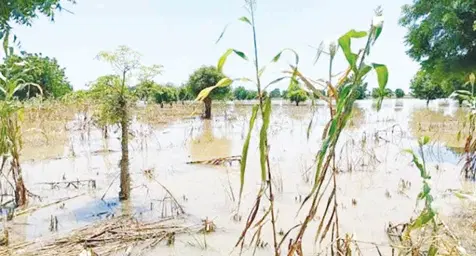
Farmers in many parts of Nigeria are reporting heavy losses after recent downpours triggered flooding that submerged farmlands and affected agricultural activities across the country.
Findings by Vanguard AgroBiz indicate that crop and livestock farmers are struggling to cope with the impact of the flooding on their businesses, with concerns that the situation could worsen.
The Nigeria Hydrological Services Agency (NiHSA) had earlier warned that 17 states, including Bauchi, Edo, Imo, Kaduna, Plateau and Benue, as well as 11 other states, could experience flooding between July 21 and July 27.
In Rivers State, the Chairman of the All Farmers Association of Nigeria (AFAN), Rivers State Chapter, Akandu Nwagwuagwu, said flooding in Tai, Eleme, Oyigbo, Etche and other areas had caused losses worth billions of naira to both crop and livestock farmers.
According to him, the floods destroyed crops, poultry, fish, goats and other livestock across the affected communities.
Nwagwuagwu, who shared a video showing the submerged Elema farm road, said that as of July 16, the flooding had washed away farmlands and damaged crops, property and other assets.
In the video, a farmer appealed to the Rivers State Government and agencies such as the National Emergency Management Agency (NEMA) for urgent assistance and a lasting solution to the recurring flooding problem. He also claimed that an 18-year-old boy died on the Elema farm road during the flooding.
The National President of the Potato Farmers Association of Nigeria (POFAN) and Deputy National President of AFAN also confirmed receiving reports of severe flood damage affecting farmers in Rivers, Anambra, Bayelsa and other states.
He called for stronger preventive measures, including improved early warning systems, agricultural insurance, financial support from federal to local governments and increased public awareness.
The acting National President of the Small Scale Women Farmers Organisation in Nigeria (SWOFON), Mrs. Ojo Florence, said reports shared within the association indicated that farms belonging to members in Rivers State were badly affected by the floods.
In Lagos State, vegetable farmer Ajose Oluwaseun of the Igbonla Farm Settlement in Epe said flooding on June 25, 2026 submerged his entire farmland.
Oluwaseun said he lost about N40 million, which he had invested in tomato and habanero pepper production.
He explained that after overnight rainfall, his workers sent him a video on June 29 showing that floodwaters had swept away nearly half of the farm while harvesting was ongoing.
He added that continuous rainfall from July 12 to July 15 later submerged more than 95 per cent of the farm.
According to him, expected corn output also dropped sharply, with one section producing only 650 kilograms instead of the projected 1.2 tonnes because of excess water.
He said that as of July 16, he had been unable to return to the farm because floodwaters had cut off access to the area about four kilometres from the settlement.
Speaking in a television interview monitored in Lagos, Niger State Governor Umar Bago said farmlands across the state had been damaged by the overflow of the Kainji, Jebba, Shiroro and Zungeru dams following heavy rainfall.
The governor said the overflowing dams had continued to affect communities and destroy agricultural land across Niger State.
However, the National President of the National Onion Producers, Processors and Marketers Association of Nigeria (NOPPMAN), Aliyu Isah, said onion farmers in major producing states had not recorded flooding incidents this season.
He attributed this to early precautionary measures taken after weather forecasts and previous flood experiences, adding that onion production remained stable in Plateau, Bauchi and Kaduna states.
