

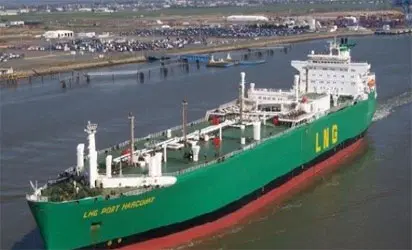
Nigeria’s Liquefied Natural Gas (LNG) exports increased by one million metric tonnes in 2025, reaching 14.78 million metric tonnes, with an estimated value of N20.06 trillion, according to the 2026 World LNG Report.
The latest figure represents an increase from 13.78 million metric tonnes exported in 2024, which was valued at approximately N18.89 trillion.
Based on the prevailing global LNG price of about 990 dollars per metric tonne, Nigeria’s 2025 exports were estimated to be worth 14.63 billion dollars, equivalent to about N20.06 trillion using the official exchange rate of N1,371 to one US dollar.
The report ranked Nigeria as the seventh-largest LNG exporter in the world, accounting for 3.4 per cent of global LNG exports in 2025.
Only the United States, Qatar, Australia, Russia, Malaysia, and Indonesia exported more LNG than Nigeria during the year.
Nigeria’s improved performance also contributed to Africa’s overall LNG exports, which increased by 1.8 million metric tonnes to 39.77 million metric tonnes, despite lower export volumes from Algeria and Egypt.
Globally, LNG trade reached a new record of 436.98 million metric tonnes in 2025, representing an increase of 25.74 million metric tonnes, or 6.3 per cent, compared to the previous year.
According to the report, the growth in global LNG trade was driven largely by increased production from the United States, Qatar, Malaysia, Angola and Nigeria.
Within Africa, Nigeria remained one of the continent’s leading LNG exporters alongside Angola, which also recorded higher export volumes during the year.
The report noted that Mauritania and Senegal also joined the list of LNG-exporting nations following the commencement of production at the Greater Tortue Ahmeyim project.
Nigeria’s stronger export performance comes as the Federal Government continues to implement its Decade of Gas Initiative, aimed at increasing gas production, expanding domestic utilisation and boosting foreign exchange earnings from natural gas.
The report added that the higher export volumes indicate improved use of Nigeria’s existing LNG infrastructure, although challenges such as domestic gas supply constraints, pipeline security and the need for greater upstream investment remain key issues for the sector.
