

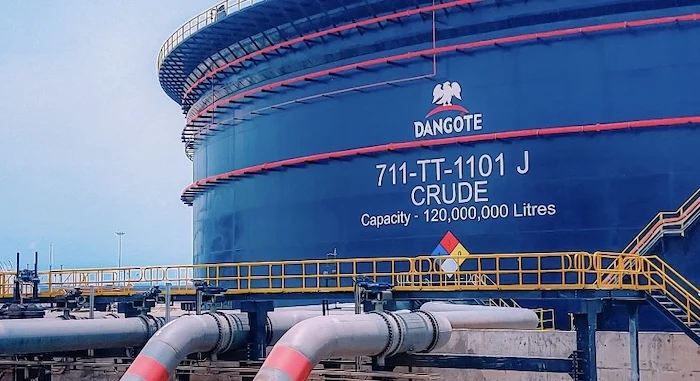
Dangote Industries Limited has commenced preliminary work on its proposed 700,000-barrels-per-day refinery in Kenya, marking a major step toward what is expected to become East Africa’s largest oil refining project.
The company said the project has moved beyond the planning stage, with the site already selected, soil investigations underway, and engineering and design activities in progress ahead of full-scale construction.
The proposed refinery, estimated to cost 17 billion dollars, will be located on Lamu Island along Kenya’s coast and is expected to supply refined petroleum products to Kenya and neighbouring countries, reducing the region’s dependence on imported fuel.
According to reports, the refinery is designed to replicate the Dangote Petroleum Refinery in Lagos and will have the capacity to process about 700,000 barrels of crude oil per day when completed.
The project is expected to become Dangote Group’s largest refining investment outside Nigeria and forms part of the company’s strategy to expand refining capacity across Africa.
Dangote Industries’ Vice President for Oil and Gas, Devakumar Edwin, said significant progress has already been made on the project.
According to him, the project site has been selected, soil testing is ongoing, while engineering and design work has commenced.
He noted that Kenya had always been the preferred location for the refinery, adding that the coastal town of Lamu was chosen for commercial and technical reasons.
Reports also indicated that Tanzania was initially considered before Kenya emerged as the preferred destination.
Kenyan President William Ruto had earlier announced that construction of the refinery was expected to begin this year following discussions with Dangote.
The refinery is expected to take several years to complete and will supply refined petroleum products across East Africa, strengthening regional energy security and reducing reliance on imported fuels.
Expansion Plans Across Africa
The Kenyan refinery is part of Dangote Industries’ broader expansion strategy aimed at increasing its refining footprint across the continent.
The company is simultaneously expanding the capacity of its Lagos refinery from 700,000 barrels per day to 1.4 million barrels per day by 2028, a move that is expected to make the Nigerian complex one of the largest refining facilities in the world.
Once both projects are completed, Dangote Industries plans to increase its combined refining capacity to 2.1 million barrels per day, comprising 1.4 million barrels per day in Nigeria and 700,000 barrels per day in Kenya.
The company also disclosed plans to invest an additional 46 billion dollars between 2026 and 2028 across its refining, cement and fertiliser businesses as part of efforts to accelerate industrialisation across Africa.
According to Devakumar Edwin, funding for the Kenyan refinery will come through a combination of internally generated revenue, bond issuances and proceeds from the company’s planned Initial Public Offering (IPO).
Although he did not disclose the project’s final cost, Edwin said it would be comparable to the Lagos refinery, which eventually exceeded 20 billion dollars before commencing operations in 2024.
Boost for Africa’s Energy Security
The proposed Kenyan refinery comes at a time when many African countries are increasing investment in local refining to reduce dependence on imported petroleum products.
Despite producing significant volumes of crude oil, Africa continues to export much of its crude while importing most of its refined petroleum products because of limited refining capacity.
Industry data indicate that Africa accounts for about seven per cent of global crude oil production, yet the continent imports nearly 70 per cent of the refined petroleum products it consumes.
The successful operation of the Dangote Refinery in Nigeria has renewed interest in domestic refining projects across the continent.
Several African countries, including Mozambique and Uganda, are also pursuing new refinery projects aimed at improving energy security, reducing foreign exchange pressures and supporting industrial development.
When completed, the Kenyan refinery is expected to strengthen fuel supply across East Africa, boost regional trade in refined petroleum products and contribute to the African Union’s broader goals of industrialisation and regional energy integration.
