

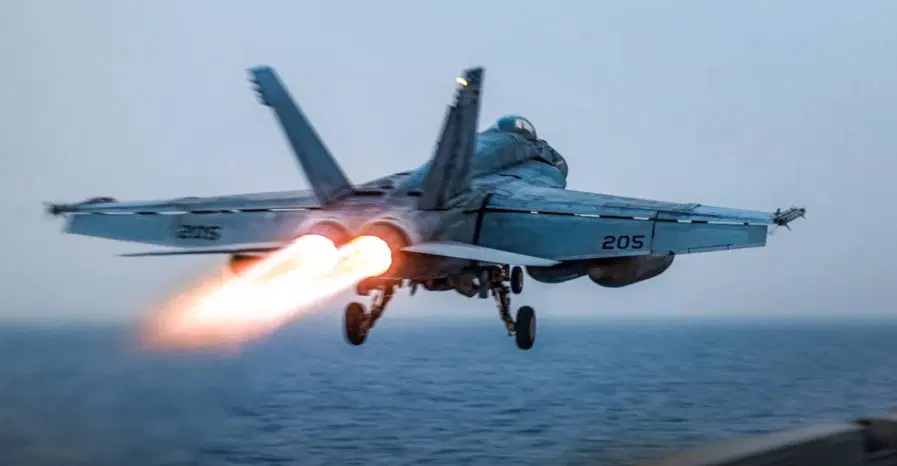
Renewed hostilities between the United States and Iran have intensified after the US launched extensive strikes on Iranian military targets in response to attacks on commercial ships in the strategic Strait of Hormuz.
The latest exchange of attacks has placed additional pressure on the interim agreement aimed at ending the Middle East conflict and has pushed global oil prices to their highest level in two weeks.
According to the US military, the strikes were carried out after Iran allegedly attacked three commercial vessels navigating the Strait of Hormuz. At the same time, Washington revoked temporary sanctions waivers that had allowed certain Iranian oil exports.
Iranian state media reported multiple explosions around the Strait of Hormuz, including incidents on Qeshm Island, the city of Sirik, and the major port city of Bandar Abbas.
In response, Iran’s Islamic Revolutionary Guard Corps (IRGC) said it launched attacks on dozens of US military facilities in Bahrain and Kuwait, according to a statement broadcast by state television.
The United States Central Command (CENTCOM) said its forces struck more than 80 targets, including Iranian air defence systems, coastal radar installations and dozens of IRGC patrol boats.
According to CENTCOM, the operation was aimed at reducing Iran’s ability to launch further attacks against international shipping passing through one of the world’s busiest trade routes.
Iran’s chief negotiator, Mohammad Bagher Ghalibaf, accused Washington of violating the existing memorandum of understanding by restoring oil sanctions and carrying out military operations in the Strait.
Authorities in Bahrain and Kuwait later confirmed that their air defence systems had been activated following the attacks, although no immediate reports of damage were released.
The latest US military action came shortly after the US Treasury Department cancelled a licence introduced in June that had temporarily allowed Iran to produce, sell and export crude oil and related petroleum products until August 21.
A US official, speaking anonymously, said Iran’s actions in the Strait of Hormuz were unacceptable and would attract consequences. The official maintained that the US-Iran memorandum of understanding remains performance-based, adding that any benefits for Tehran would depend on its compliance with the agreement.
Despite the renewed confrontation, the official said US negotiators remain engaged in efforts to reach a final settlement with Iran.
Commercial Ships Targeted Near Hormuz
The British maritime security agency, UKMTO, reported that an unidentified projectile struck a tanker near the Strait of Hormuz, causing a fire, before two additional vessels were attacked, with at least one reportedly hit by a drone.
CENTCOM identified the affected vessels as the Marshall Islands-flagged Al Rekayyat, the Saudi Arabia-flagged Wedyan, and the Liberia-flagged Cyprus Prosperity.
The ships were reportedly attacked near the coast of Oman, where authorities have proposed a temporary maritime transit corridor. Iran has opposed the proposal, insisting on greater control over shipping movements through the narrow waterway.
Qatar condemned the attack on the Al Rekayyat, describing it as an unacceptable assault on international maritime navigation, and summoned Iran’s deputy ambassador to register an official protest.
Iran rejected Qatar’s accusations, describing them as unacceptable in a statement carried by its state news agency.
Oil Prices Rise as Security Concerns Grow
The renewed conflict has renewed concerns over global energy supplies, with oil prices rising by more than two per cent during early Asian trading on Wednesday.
Security analyst Andreas Krieg of King’s College London said the latest developments suggest Iran is determined to maintain influence over maritime traffic in the Strait of Hormuz and is opposed to any alternative shipping arrangements that bypass its authority.
He warned that vessels attempting to use alternative routes without complying with Iran’s requirements could face further attacks, describing the incidents as a violation of both the ceasefire agreement and international law.
Although maritime traffic had gradually resumed following last month’s US-Iran memorandum of understanding, Tehran has maintained that shipping through the Strait will not return to pre-conflict arrangements.
Under the agreement, Iran and Oman are expected to hold discussions with other Gulf states on the future administration and maritime services within the Strait of Hormuz.
Qatar, which had earlier declined mediation efforts during the height of the conflict, has since taken a more active diplomatic role by hosting indirect talks between Iran and the United States aimed at achieving a lasting agreement.
