

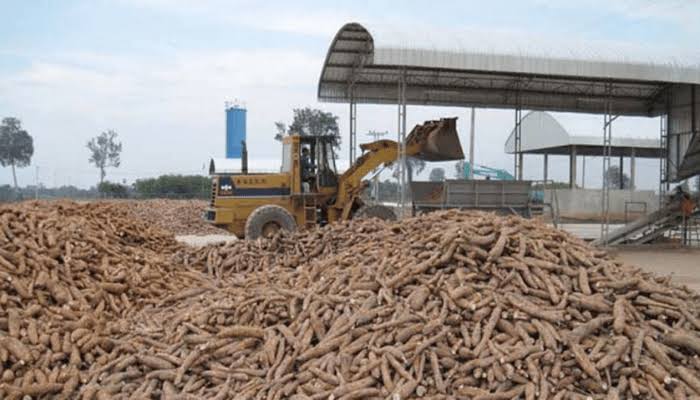
ACCORDING TO VANGUARD NEWSPAPER Nigeria’s cassava processing industry is facing a deepening crisis as imports of cassava starch surged by 13,293 per cent in five years, leaving local factories struggling, farmers counting their losses and processors operating at low 15 per cent of their installed capacity.
This is happening despite Nigeria’s position as the world’s largest cassava producer as of 2024, according to the Food and Agriculture Organization Corporate Statistical Database, FAOSTAT, an agency of the United Nations.
Industry stakeholders attributed the crisis to high production costs, inadequate financing, declining farm acreage and weak enforcement of import restrictions. These factors have made imported alternatives cheaper than locally produced cassava derivatives.
The situation has resulted in a glut of raw cassava, falling farm-gate prices, mounting debts among farmers and processors, and growing concerns about the future of local industrial production.
Data obtained from the World Bank’s World Integrated Trade Solution, WITS, based on UN Comtrade records, showed that Nigeria’s cassava starch imports rose from 24.1 tonnes in 2020 to 3,227.7 tonnes in 2025, representing a 13,293 per cent increase over five years.
A year-on-year breakdown showed that Nigeria imported 24.1 tonnes of cassava starch, valued at $69,440, in 2020.
Imports increased by 126.6 per cent year-on-year (YoY) in 2021 to 54.6 tonnes, worth $154,750. In 2022, the volume surged by a further 272.2 per cent YoY to 203.2 tonnes, valued at $292,900.
However, following a sharp rise in the exchange rate, imports plunged by 98 per cent YoY in 2023 to 4.1 tonnes, valued at $32,080, before rebounding sharply in 2024 by 73,004.9 per cent to 2,997.3 tonnes, worth $2.34 million.
The upward trend continued in 2025, with import volumes rising by 7.7 per cent to 3,227.7 tonnes. However, despite the increase in volume, the value of imports declined by 7.6 per cent to $2.16 million from approximately $2.34 million in 2024.
Industry stakeholders, who spoke in exclusive interviews with Financial Vanguard, warned that imports were rising further in 2026 and could continue to increase in subsequent years unless the government addressed the cost disadvantages confronting local processors and strengthened policies supporting domestic production.
