

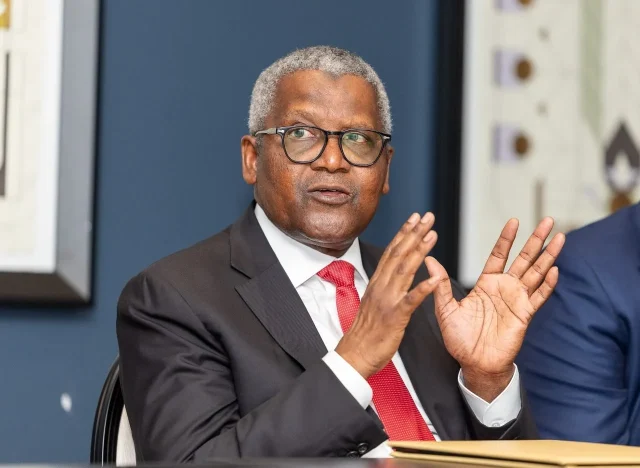
President of the Dangote Group, Aliko Dangote, has accused local petroleum marketers and international oil companies of fuelling protests over land designated for his proposed $16 billion refinery project in Lamu, Kenya.
Dangote and Kenyan President William Ruto performed the groundbreaking ceremony for the refinery on Wednesday, despite a court order restricting construction activities over a land dispute.
Speaking on the BBC’s Focus on Africa programme, Dangote dismissed concerns raised by some residents over compensation for land acquired for the project and rejected claims that the company had taken more land than was allocated by the Kenyan Government.
He described the protests as “games played by local marketers and international players” and maintained that the refinery project would proceed as planned, with completion targeted for 2030.
The facility is expected to have a processing capacity of 700,000 barrels per day and, if completed, would become the largest refinery in East Africa.
The groundbreaking ceremony was attended by the leaders of Uganda, Ethiopia, Togo and Benin. According to Reuters, Dangote has offered regional governments a combined 30 per cent stake in the refinery.
Dangote described the project as his largest proposed investment outside Nigeria and said it would demonstrate that the success achieved with his 700,000 barrels-per-day refinery in Nigeria could be replicated elsewhere in Africa.
The project is also expected to become Kenya’s biggest infrastructure development since independence, surpassing the $5.1 billion Standard Gauge Railway.
However, the Save Lamu campaign group has raised environmental concerns over the proposed refinery. Its co-founder, Walid Ali, told the BBC that residents wanted access to the findings of the environmental impact assessment and details of proposed measures to address potential effects on the community.
A total of 133 Lamu residents approached the Kenyan High Court seeking to halt construction. As a result, activities including excavation and construction on the disputed land have been restricted pending the next court hearing scheduled for October 14.
Dangote said the refinery could create about 60,000 jobs at the peak of construction, with local communities expected to benefit.
The project will also include a 1,000-megawatt power plant intended to provide electricity for Dangote’s operations and other industries that may establish businesses in the area.
Source: PUNCH
