

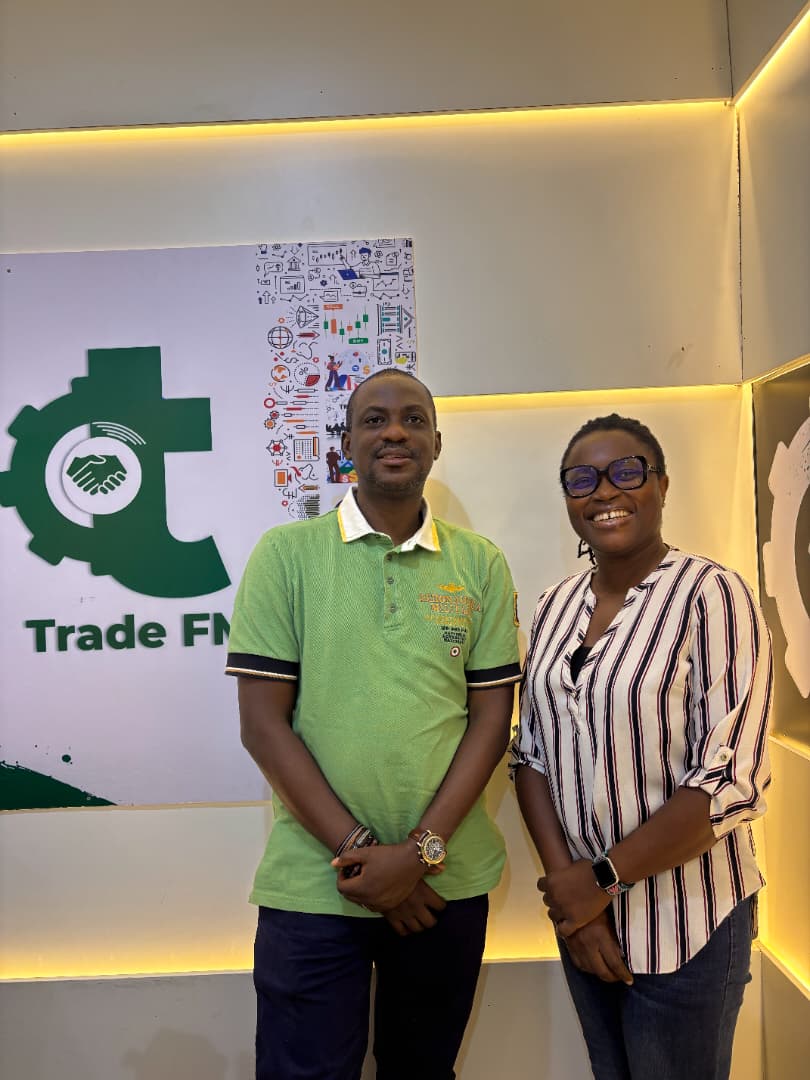
Experts in urban development and waste management have called for stronger government policies, producer responsibility and community-based recycling systems to enable Nigeria to unlock the economic value of its growing waste stream.
The experts made the call during the Ask the Experts segment of Trade FM’s Breakfast Business Briefing, where they examined opportunities in waste management, recycling and the circular economy, particularly in Lagos.
The guests were Dr Temilade Sesan, Lagos City Manager for the African Cities Research Consortium (ACRC), and Mr Deji Akinpelu, Co-founder of the Rethinking Cities Initiative and Action Research Lead on Zero Waste Management for Lagos ACRC.
Akinpelu said waste management should not be viewed solely as a business opportunity, but also as an essential public service capable of generating income and employment for communities.
He said entrepreneurs could begin on a small scale, even from their homes, by collecting recyclable materials before expanding as financing becomes available.
“You can start in your house. Your house is your first source, your first business,” Akinpelu said.
He, however, stressed that scaling recycling businesses would require greater access to finance and stronger support from manufacturers whose products eventually become waste.
According to him, producer responsibility should extend beyond plastics to other waste streams, including electronic waste, particularly as low-cost electronic devices with short lifespans become increasingly common.
Integrating informal waste workers
The experts also highlighted the important role of informal waste workers in Nigeria’s recycling value chain.
Akinpelu said informal waste collectors often have a competitive advantage over formal businesses because they operate with significantly lower overhead costs.
He called for deliberate efforts to integrate them into the formal recycling value chain rather than treating them as a separate system.
“They exist whether you like it or not. More intentionality [is needed] in integrating them into that overall waste stream so that collectively more value can be extracted and also better redistributed in terms of profits across the value chain,” he said.
He also identified food waste as a largely untapped area of opportunity, noting that organic waste could be collected from households and businesses and converted into compost, biogas or energy.
Akinpelu said such initiatives could create income opportunities, particularly for low-income and vulnerable communities.
He advocated the establishment of community-based hubs where recyclable materials and food waste could be collected, sorted and processed.
Waste management as both business and public service
Sesan said the debate should go beyond whether waste management is simply a business or a government service.
She noted that Lagos faces a combination of high population, increasing consumption, limited infrastructure and varying income levels, making it necessary to develop models that respond to the realities of communities.
Recalling her experience in Dar es Salaam, Tanzania, Sesan said the city government had invested in a bottom-up approach by supporting community-based organisations involved in waste recovery and recycling.
She said some organisations operated small material recovery facilities that enabled waste to be separated and processed closer to where it was generated.
“It can be both, but even that business has to be in the service of the service,” Sesan said.
According to her, locally based organisations and small businesses can make profits while still providing essential waste management services to their communities.
She argued that the closer recycling and waste management enterprises are to communities, the more effectively they can deliver those services.
Call for mandatory producer responsibility
The experts also urged the government to move beyond voluntary corporate social responsibility initiatives by making producers accountable for the environmental impact of their products.
Akinpelu said manufacturers should have clearly defined obligations for products after consumers have finished using them.
“It’s not a concept of CSR, or somebody trying to do somebody a favour,” he said, stressing that producers should take responsibility for the end-of-life management of their products.
He advocated a system where manufacturers would be required to recover increasing percentages of their products each year and invest a defined proportion of their profits in recycling initiatives.
He also called for greater attention to product design, arguing that manufacturers should consider recyclability from the beginning.
“How do you design your products? Do you design things that are easily recycled?” he asked.
The experts said such measures could help shift responsibility from consumers alone to the entire production and consumption chain.
Government urged to create enabling environment
On measures that could encourage greater private-sector investment in recycling, Akinpelu called for clearer pricing mechanisms, standardisation and designated spaces for recycling activities.
He said recyclers need greater certainty about the value of materials collected and how much of those materials are ultimately processed and recycled.
He also called on local governments to create designated areas for recycling hubs as part of urban planning.
According to him, Lagos needs to deliberately incorporate recycling facilities into its city plans instead of leaving recycling activities to develop without adequate space or infrastructure.
Sesan supported the call, citing an example from Dar es Salaam where an underutilised government research facility was provided to a recycling business at no cost.
She said the facility enabled the business to process plastics and other materials sourced directly from informal waste workers.
“It wasn’t even about creating [new facilities]. It would be good to create the hubs as well, but even starting from where we are, sort of giving that space,” Sesan said.
She said such an approach could allow governments to put underutilised public assets to productive use while creating opportunities for entrepreneurs.
Investment in young people and education
Sesan further called for greater investment in young people through entrepreneurship programmes, government support and curriculum reforms.
She argued that university programmes should be better aligned with emerging economic and environmental challenges, including waste management and recycling.
According to her, environmental management courses should be linked more closely to entrepreneurship and the practical realities of the waste economy.
She said young people should be introduced to opportunities in the sector early enough to develop the knowledge and interest required to build businesses around recycling and resource recovery.
Infrastructure needed to change public behaviour
The experts also challenged the perception that Nigerians simply lack knowledge about recycling.
Sesan said many people already understand the value of recyclable materials, but the absence of appropriate infrastructure often makes proper waste separation difficult.
She cited practices in the United Kingdom, where collection systems and packaging regulations encourage people to separate waste and make recycling easier.
“People need to be nudged to make the right decision,” she said, explaining that behaviour is influenced by the infrastructure and systems surrounding individuals.
Sesan noted that asking households to separate their waste would have limited impact if collection systems subsequently mix the materials together.
“If I separate my waste, where is it going? Is the PSP truck going to have a separate compartment for food waste, solid waste? If that’s not the case, then people are not going to be incentivised to do that,” she said.
Akinpelu also advocated greater public awareness and a return to some traditional practices, such as reusing shopping bags and growing food around homes.
He said food waste, including materials such as banana peels, could be repurposed through composting and other processes rather than being discarded.
The experts said Lagos’ waste challenges should therefore be viewed not only as an environmental problem but also as an opportunity to create jobs, develop businesses, support communities and generate economic value from materials that would otherwise end up in dumpsites.
