

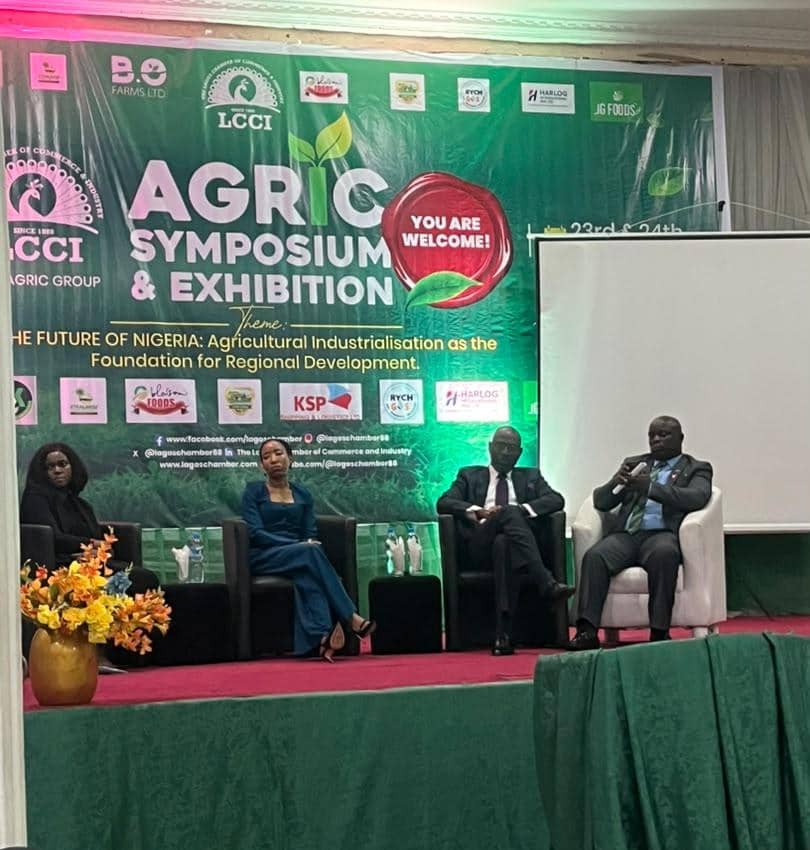
The Lagos Chamber of Commerce and Industry (LCCI), the Nigerian Export Promotion Council (NEPC) and private-sector stakeholders have called for increased investment in agricultural processing, infrastructure and value addition to enable Nigeria to reduce food imports and expand its non-oil exports.
Speaking at the LCCI Agriculture Symposium and Exhibition in Lagos, LCCI President, Engr. Leye Kupoluyi, said increased agricultural production alone could not guarantee food security without adequate processing, storage, financing, logistics and market access.

Kupoluyi noted that agriculture grew by 4.39 per cent in the second quarter of the year, compared with 2.82 per cent in the corresponding period of 2025, contributing about 26 per cent to Nigeria’s Gross Domestic Product.
However, he said the country spent about N3.33 trillion on food and beverage imports in the first six months of the year, while the annual food import bill rose from N3.8 trillion in 2023 to N6.5 trillion in 2024 and N7.65 trillion in 2025.
He described the figures as evidence of an unfinished agricultural value chain, stressing the need to move beyond the production of raw commodities to processing, storage, logistics and market development.
Kupoluyi also expressed concern over declining profitability in some agricultural value chains, citing rice production in Kebbi State, where fewer than 30 per cent of about 500,000 registered rice farmers reportedly participated in the 2026 dry-season production due to falling paddy prices and rising input costs.
He said Nigeria was also losing economic opportunities by exporting raw commodities such as cassava and cocoa and importing processed products, including starch, chocolate and animal feed.
The LCCI president identified the Special Agro-Industrial Processing Zones programme as one initiative capable of addressing the challenge. He said the $530 million programme, co-funded by the Federal Government, the African Development Bank and the Islamic Development Bank, covers Kaduna, Kano, Kwara, Cross River, Imo, Oyo and the Federal Capital Territory.
Also speaking, NEPC Southwest Regional Coordinator, Benedict Itegbe, said the region could contribute between $9 billion and $10 billion to Nigeria’s non-oil exports by 2035 if it prioritises agro-processing and export-oriented industrialisation.
Itegbe identified cocoa, cashew, cassava, oil palm, shea, seafood, soybeans, sesame, ginger and horticultural products as key value chains with export potential.
He said Nigeria currently captures only about five to 10 per cent of the global market share in some agricultural products where it is a leading producer, stressing that greater investment in processing and industrial capacity was needed to unlock their value.
According to him, Nigeria’s non-oil exports grew by 11.5 per cent in 2025, while cocoa exports were valued at about $2 billion and cashew at roughly $500 million.
Itegbe projected that the cocoa complex alone could generate about $4 billion in exports by 2035, while the Southwest could contribute up to $10 billion to Nigeria’s non-oil export earnings.
He called for improved access to finance and insurance, stronger offtake arrangements, better logistics and infrastructure, technology, traceability and automation across agricultural value chains.
The Managing Director of Funtura Food and Drinks Limited, Tolulola Olumide, similarly urged stronger investment, predictable policies and improved infrastructure to enable Nigeria to move from food import substitution to export creation.
Olumide said Nigeria had the land, human resources and entrepreneurial capacity to develop a strong agricultural industrial base, but required an ecosystem capable of supporting farmers and businesses across the entire value chain.
She called for patient capital to support long-term investments in processing plants, irrigation, hatcheries and breeding programmes, while urging government to provide infrastructure, policy stability and measures that reduce investment risks.
Olumide cited the export of table eggs by Animal Care Services Consult Nigeria Limited to neighbouring countries in 2024 and 2025 as evidence that Nigerian agricultural businesses can meet international standards and access foreign markets.
She said agriculture should be viewed not only as a means of producing food but also as a platform for industrial development, job creation, foreign exchange earnings and economic resilience.
The stakeholders therefore urged government and the private sector to strengthen collaboration and ensure that agricultural investment translates into higher productivity and farmer incomes, affordable food, reduced imports, increased exports and greater local processing capacity.
