

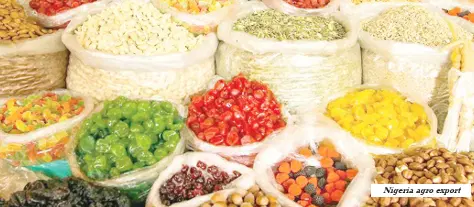
Nigeria’s agricultural export earnings declined by 36.09 per cent year-on-year to N802.99 billion in the second quarter of 2026, according to the latest data from the National Bureau of Statistics.
The figure was down from the N1.26 trillion recorded in the corresponding quarter of 2025.
The NBS data also showed that agricultural exports fell by 31.51 per cent compared with the N1.17 trillion recorded in the first quarter of 2026.
Cashew nuts in shell accounted for the largest share of agricultural exports during the quarter, valued at N268.62 billion.
They were followed by standard quality cocoa beans at N154.31 billion, sesame seeds at N96.03 billion, superior quality cocoa beans at N58.82 billion and soya beans, excluding seeds, valued at N50.22 billion.
The data showed that Nigeria’s agricultural products continued to find markets mainly across Asia and Europe, with countries including India, Malaysia, the Netherlands, China and Vietnam among the destinations.
The decline in agricultural exports comes despite an overall increase in Nigeria’s merchandise exports in the quarter. Total exports reached N27.02 trillion in Q2 2026, while agricultural exports recorded a significant decline.
Agriculture requires support from other sectors
Stakeholders in the agricultural sector have called for stronger local processing, improved infrastructure, easier access to finance, reliable electricity, better quality control and stronger connections between farmers and international markets.
The Lagos State Commissioner for Agriculture and Food Systems, Abisola Olusanya, said Nigeria would struggle to significantly expand its agricultural exports if the sector continued to be treated as the responsibility of farmers or a single government ministry.
Speaking at a press conference in Lagos, Olusanya said agriculture must be integrated with other parts of the economy, including energy, finance, data, infrastructure and logistics.
She explained that the various components of the agricultural value chain are interconnected and should not be addressed separately.
Olusanya said Nigeria could only turn agriculture into a major source of export earnings by bringing together the different sectors that support production and distribution.
She stressed that agriculture, energy, data and finance must work together rather than being handled as separate policy areas.
Source: Vanguard
