

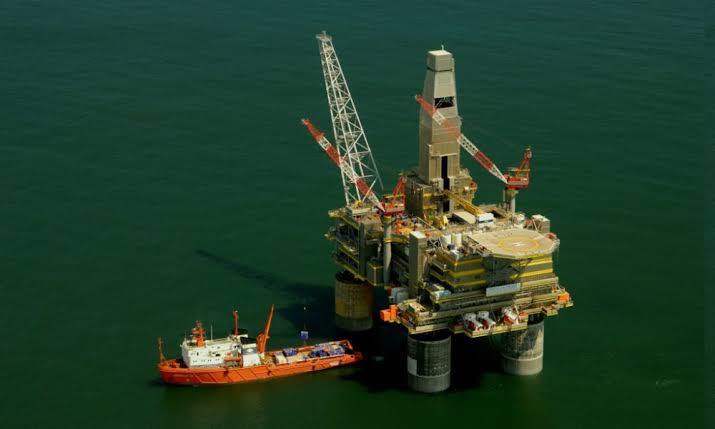
Nigeria’s rising deployment of oil rigs over the past decade has failed to produce a corresponding increase in crude oil output, with industry experts blaming declining production from ageing fields and delays in developing new wells.
Data from the Organisation of Petroleum Exporting Countries, OPEC, showed that 2,099 rigs were deployed in Nigeria between 2016 and 2026, representing investments worth billions of dollars.
The highest annual rig deployment was recorded in 2018, with 360 rigs, while 2021 had the lowest figure at 87 rigs.
Industry estimates indicate that deepwater drilling alone can cost between US$400,000 and US$600,000 per day for the rig, excluding expenses for drilling mud, casing, cementing, logistics, helicopters, supply vessels, insurance and other services.
A single offshore exploration well may cost between US$50 million and over US$150 million, depending on its depth and complexity.
Despite these huge investments, Nigeria’s highest crude oil production, excluding condensate, during the period was 1.734 million barrels per day, bpd, in 2019. Production later fell to 1.143 million bpd in 2022.
Mature Fields Record 20.8% Output Decline
The pressure on production has also been reflected in the performance of mature oil assets.
Data from the Nigerian Upstream Petroleum Regulatory Commission, NUPRC, showed that average production from five mature fields dropped by 20.8 per cent year-on-year to 10,930 bpd in June 2026, compared with 13,794 bpd recorded in June 2025.
Mature fields are oil assets that have been producing for several years and have passed their peak production phase. Such fields often experience declining reservoir pressure, increased water production and falling output, making additional investment and enhanced recovery measures necessary.
The Abo field, operated by Eni/Agip and producing since 2003, recorded a 39.2 per cent decline, falling from 11,297 bpd in June 2025 to 6,870 bpd in June 2026.
Pennington, operated by Pennington Producing Limited, dropped by 45 per cent from 7,107 bpd to 3,880 bpd.
Ugo Ocha, also known as Jones Creek, declined by 16.6 per cent from 32,246 bpd to 26,900 bpd.
Sea Eagle, operated by Renaissance Energy, recorded an 8.3 per cent decline from 15,886 bpd to 14,570 bpd, while Okwori, operated by Antan Producing Limited, slipped slightly from 2,435 bpd to 2,430 bpd.
Investigations across Abia, Akwa Ibom, Bayelsa, Cross River, Delta, Edo, Imo, Ondo and Rivers states indicate that several oil fields have suffered substantial depletion since Nigeria’s first commercial oil discovery in 1956.
While some operators have continued to invest in new wells, workovers and other production-enhancement measures, others have faced difficulties in providing the capital needed to sustain output.
Operators Say They Are Working to Sustain Production
Renaissance Africa Energy, operator of the Sea Eagle field, said the decline in production was expected because of the field’s maturity.
The company said Sea Eagle’s production profile is consistent with its approved Field Development Plan and that its natural decline has already been factored into its business and growth strategy.
Renaissance added that it is assessing and implementing measures to improve production and maximise the value of its assets, while maintaining operational reliability and complying with regulatory requirements.
Eni also described the Abo field as a mature asset, noting that it began production in April 2003 and has remained operational for 23 years.
The company said it is implementing measures to optimise production, including upgrades to gas compressors.
Nigeria’s OPEC+ Influence Weakens
Nigeria’s prolonged production challenges have also reduced its influence within OPEC and the wider international oil market.
Historical data showed that Nigeria’s crude production reached about 2.5 million bpd in November 2005, placing the country among the major players in OPEC.
However, even with investment efforts following the Petroleum Industry Act, PIA, national production, including condensate, has remained below 1.7 million bpd.
Nigeria was also absent from the seven OPEC+ countries that participated in a virtual meeting on August 2, 2026, to assess market conditions and production prospects.
The seven countries — Saudi Arabia, Russia, Iraq, Kuwait, Kazakhstan, Algeria and Oman — agreed to adjust production by 188,000 bpd from the additional voluntary cuts announced in April 2023. The adjustment is scheduled to take effect in September 2026.
OPEC said the measure would also allow the participating countries to accelerate compensation for previous overproduction.
The countries reaffirmed their commitment to complying with the Declaration of Cooperation and compensating for excess production recorded since January 2024.
They are expected to continue holding monthly meetings to assess developments in the oil market.
Industry analysts say Nigeria risks losing substantial revenue as ageing fields, inadequate investment, crude theft, pipeline vandalism and delays in new projects continue to limit production.
While other OPEC+ members are adjusting output to influence global prices and maximise earnings, Nigeria is still struggling to meet its production allocation and satisfy the growing crude requirements of newly established domestic refineries.
Experts Call for Urgent Action
An industry expert who spoke anonymously said Nigeria needs to combine exploration with faster development of oil fields and stronger recovery efforts from existing assets.
The expert said exploration alone would not solve the country’s production problems, stressing the need for enhanced recovery from mature fields, better security, upgraded infrastructure and faster regulatory approvals.
According to the expert, Nigeria already has substantial proven reserves, making the bigger challenge the conversion of those reserves into stable and sustained production rather than simply discovering more oil.
