

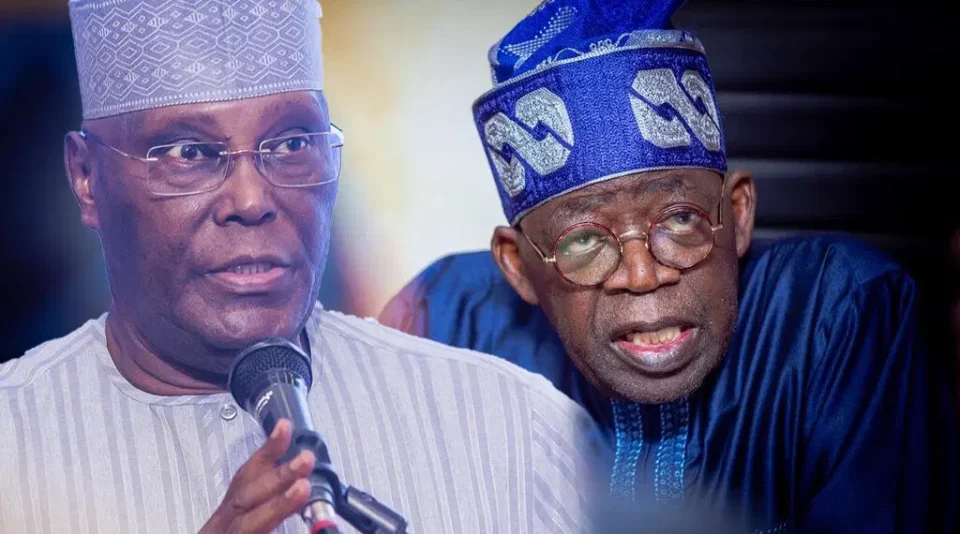
President Bola Tinubu and former Vice President Atiku Abubakar have disagreed over the possibility of reintroducing petrol subsidy ahead of the 2027 general election.
While Tinubu criticised Atiku’s proposal to restore subsidy, describing it as evidence of a lack of understanding of governance and the economy, the African Democratic Congress (ADC) presidential candidate unveiled a new model focused on supporting local refineries rather than subsidising imported fuel.
Tinubu spoke on Thursday while receiving Osun State Governor Ademola Adeleke at the Presidential Villa in Abuja.
The President said returning to fuel subsidy would be a step backwards, recalling that before he assumed office, 27 states struggled to meet salary obligations, including payments to pensioners.
He argued that government policies and infrastructure projects were now providing citizens with tangible benefits through improved roads, housing, school rehabilitation, healthcare and the training of teachers and health workers.
Tinubu also urged Adeleke to use his electoral victory to promote unity, peace, democracy and the rule of law, while avoiding the stigmatisation of political opponents.
The Osun governor, who recently secured re-election, said his visit to the Presidential Villa was to appreciate Tinubu for supporting democracy and allowing what he described as a free and fair election.
Atiku Proposes New Subsidy Model
Atiku, through his Senior Special Assistant on Public Communication, Phrank Shaibu, said his proposed Economic Recovery Plan, AERP 2027, would redirect subsidy support from fuel imports to domestic refining.
He argued that the debate should not simply be about whether subsidy should exist, but whether it is administered through a transparent and accountable system that benefits Nigerians.
Under his proposal, eligible refineries would receive domestic crude at a preferential price in exchange for verified production and guaranteed local supply.
Atiku said every subsidised barrel would be monitored from crude allocation through refining and final delivery, with production figures, inventories and crude intake independently reconciled.
He proposed sanctions for operators that divert products, falsify records or fail to transfer the benefits to consumers, including withdrawal of subsidy eligibility, repayment and prosecution.
The former vice president also said both public and private refineries should be able to participate under clear rules to prevent the programme from favouring politically connected businesses.
He proposed that subsidy spending be subject to a fixed annual limit approved by the National Assembly, with independent auditors verifying production against government expenditure.
Atiku said the support would gradually reduce as Nigeria’s refining capacity expands and would operate under a statutory sunset clause, stressing that the objective was to build a strong domestic refining industry that would eventually no longer require subsidy.
He also questioned the Tinubu administration’s claim that subsidy had been completely removed, pointing to NNPC Limited’s audited accounts, which recorded about N4.84 trillion in “Energy Security Expenses” in 2023 and N7.13 trillion in 2024.
Atiku argued that Nigerians should not bear the cost of subsidy removal through higher petrol prices while also carrying what he described as unexplained subsidy-like expenses.
Presidency Rejects Atiku’s Proposal
The Presidency has rejected Atiku’s proposal, accusing him of seeking to revive the old fuel subsidy system for political reasons ahead of the 2027 election.
In a statement by the Special Adviser to the President on Information and Strategy, Bayo Onanuga, the Presidency said Atiku had previously supported the removal of subsidy but had now reversed his position.
Onanuga described the former vice president’s proposal as a return to what he called a wasteful and corruption-prone system, noting that the Petroleum Industry Act made the previous subsidy arrangement illegal from the end of June 2023.
The Presidency argued that petrol subsidy was not simply money sitting in government accounts for distribution to consumers, but represented the under-recovery suffered when NNPC sold petrol below its acquisition cost.
It said claims of a N30 trillion subsidy windfall or savings were inaccurate and maintained that restoring the former arrangement would require a clear legal, fiscal and administrative framework.
Onanuga warned that Nigeria could not afford to return to policies whose costs were hidden and later emerged as debt, reduced public spending or additional pressure on the naira.
He said discussions about the cost of living and economic policy were necessary, but maintained that such debates must reflect Nigeria’s current economic and petroleum realities rather than the conditions of the past.
