

The Abia State Government has clarified that its ongoing tax administration reforms are not intended to increase taxes but to make revenue collection more transparent, accountable and easier for taxpayers.
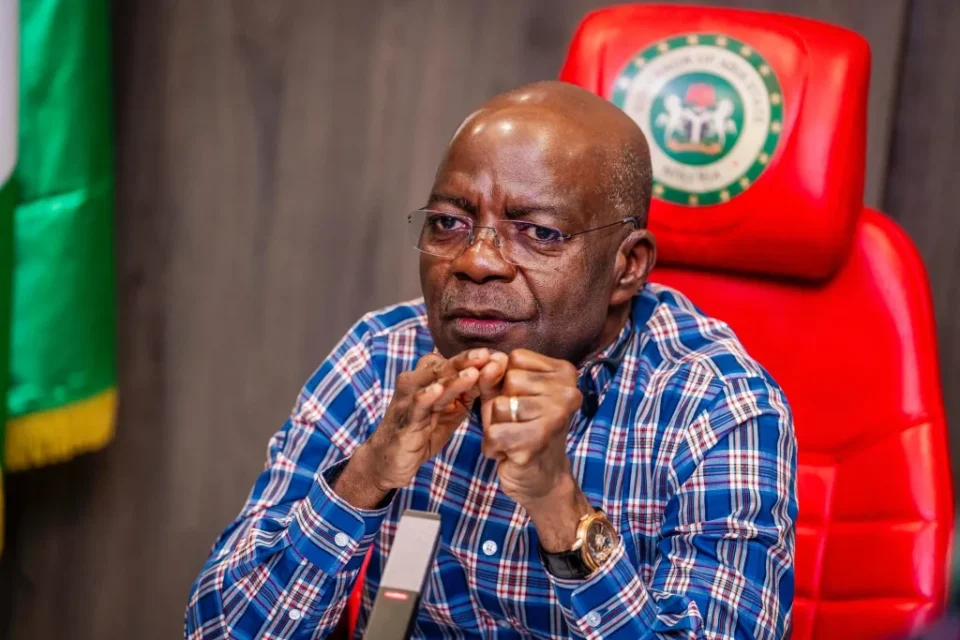
The State Commissioner for Information, Okey Kanu, made the clarification on Monday while briefing journalists at the Government House, Umuahia, after the State Executive Council meeting chaired by Governor Alex Otti.
Kanu said the reforms were aimed at making tax administration more transparent, traceable, auditable, automated and taxpayer-friendly, while reducing revenue leakages, multiple collections and arbitrary practices.
He stressed that automation and improved accountability should not be mistaken for tax increases.
According to him, the integration of revenue collection platforms, particularly at vehicle licensing offices, was introduced to reduce cash transactions and ensure that payments made by residents are properly recorded and remitted to government.
Kanu also stated that there had been no increase in Pay-As-You-Earn (PAYE), land or vehicle taxes, noting that the Abia State Board of Internal Revenue does not have the authority to independently change existing tax rates.
On the issuance of Tax Clearance Certificates, he explained that the process was being carried out in accordance with existing tax laws and the new national tax framework.
He said taxpayers would be assessed based on their actual income, rather than being subjected to a flat payment without proper assessment.
The commissioner added that the government would not automatically regard every payment or inflow into a taxpayer’s bank account as taxable income. Instead, transactions would be examined through lawful assessment and verification to determine whether they qualify as taxable income.
Also speaking, the Special Adviser to the Governor on Internally Generated Revenue, Dr Emmanuel Okpechi, said the reforms were designed to improve transparency for both government and taxpayers.
Okpechi urged residents to provide accurate information about their income, while assuring them that government would not impose taxes beyond what is legally required.
He also explained the purpose of the consolidated demand notice for businesses, saying it was introduced to combine various government charges and eliminate multiple collections.
Rather than having different agencies approach businesses separately for payments, Okpechi said taxpayers would make payments through a single point and receive clearance.
The Executive Chairman of the Abia State Board of Internal Revenue, Uche Elekwachi, similarly maintained that the government had not increased taxes.
He said the board was only enforcing existing tax laws, improving compliance and introducing systems to prevent revenue leakages.
Elekwachi specifically ruled out increases in PAYE, land taxes, vehicle licence fees and charges for obtaining Tax Clearance Certificates.
He said the government had consolidated different payments so that once a taxpayer makes the required payment, they would not be subjected to additional demand notices for the same obligations.
The board chairman also reiterated that not every bank account inflow would automatically be classified as taxable income. Taxpayers applying for Tax Clearance Certificates would be allowed to explain and provide evidence concerning the nature of their transactions during the assessment process.
Meanwhile, the Chief Press Secretary to Governor Otti, Ukoha Njoku Ukoha, said the clarification followed concerns raised by some opposition figures over the state’s tax reforms.
He explained that the new system had brought together various payments, including stallage and ASEPA fees, into a consolidated process.
The government said the reforms are intended to strengthen revenue administration while making the tax system more transparent and convenient for residents and businesses in Abia State.
