
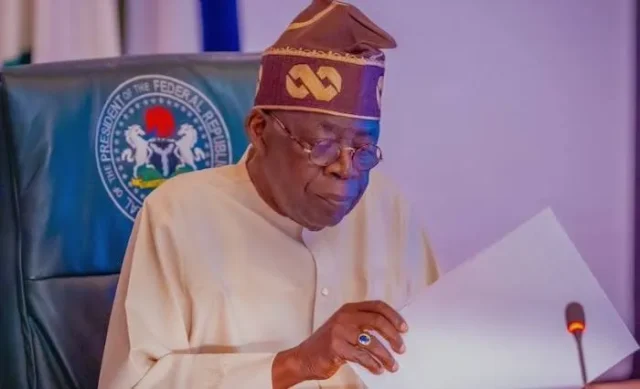
President Bola Tinubu has submitted a revised 2026 Appropriation Bill to the House of Representatives, seeking to reduce the nation’s approved budget from N68.32tn to N65.18tn while maintaining the existing fiscal deficit of N31.46tn.
The revised proposal projects Federal Government revenue of N33.72tn, including income from Government-Owned Enterprises, while allocating N26.23tn to capital expenditure.
The request was conveyed in a letter dated November 20, 2026, addressed to the Speaker of the House of Representatives, Tajudeen Abbas, and presented during Tuesday’s plenary.
Alongside the proposed amendment, Tinubu also submitted a revised 2026 Federal Government Fiscal Framework, explaining that the adjustments were necessary to bring government spending in line with available resources and existing financial commitments.
According to the President, the revised budget is expected to account for certain expenditures undertaken by the Nigerian National Petroleum Company Limited on behalf of the Federation, address previously underprovided debt-service obligations and recognise issued capital warrants and additional funding commitments.
The proposal also makes provisions for refunds to Ministries, Departments and Agencies, as well as special accounts.
Tinubu explained that the adjustments were designed to give priority to existing obligations, improve the implementation of capital projects and strengthen the credibility of the budget while maintaining fiscal discipline.
Despite the reduction in total expenditure, the fiscal deficit, including project-tied loans, remains unchanged at N31.457tn, representing 5.64 per cent of Nigeria’s Gross Domestic Product.
The President also retained the proposed borrowing target of N29.22tn, comprising N18.43tn in domestic loans and N10.79tn in external borrowing.
On foreign borrowing, Tinubu disclosed that the planned $7.7bn loan, estimated at N10.37tn using an exchange rate of N1,346.50 to the dollar, would finance the existing external borrowing provision without expanding the overall borrowing limit.
The revised framework puts aggregate government expenditure at N65.176tn, compared with N68.323tn in the original budget, while projected revenue stands at N33.720tn.
The President further explained that most of the capital allocations to MDAs under the revised proposal were amounts that had already received spending approval.
However, some additional capital and overhead provisions were introduced for priority national projects, particularly the completion of critical road infrastructure, support for agricultural production, reduction of production costs, improvement of farm yields and better market access.
The proposed adjustments also include measures to address water-related vulnerabilities.
Seeking the support of lawmakers, Tinubu urged the House of Representatives to give the bill expedited consideration and passage to ensure the orderly implementation of the revised budget and settlement of outstanding obligations.
The proposed legislation will undergo legislative scrutiny before it can take effect. If passed, it will provide the legal backing for the Federal Government to implement the adjusted spending plan.
SOURCE: PUNCH
