

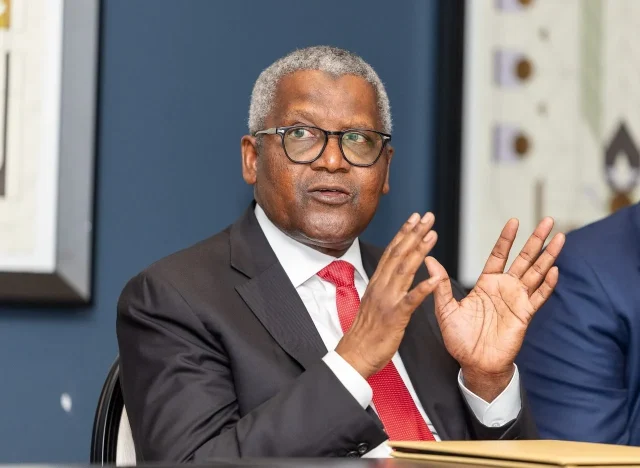
Africa’s richest man, Aliko Dangote, has disclosed plans by his conglomerate to invest more than $10 billion in the power sector over the next three to four years as part of efforts to address Nigeria’s electricity challenges and support industrialisation.
Dangote made the disclosure during an interview with Al Jazeera, where he identified inconsistent government policies and inadequate electricity supply as major factors discouraging investment across Africa.
He said the group was considering moving funds from some businesses, including steel, into electricity generation and other power-related projects.
Dangote said the planned investment would form part of what he described as a major transformation in Africa, stressing that reliable electricity was essential for economic growth.
He also expressed concern that more than 600 million Africans still lack access to electricity, saying the continent needed to urgently address the situation.
The industrialist linked reliable electricity to economic development, arguing that governments that succeed in providing power could make significant progress in improving their economies.
He said Africa would struggle to create enough jobs and achieve sustainable economic growth without industrialisation, adding that the continent needed to reduce its dependence on imported goods.
Dangote cites policy instability, power shortage
Speaking about concerns over investment in Africa, Dangote said inconsistent government policies and inadequate electricity supply had remained major obstacles.
He said government policies had changed frequently in the past, making it difficult for businesses to plan for the long term.
However, he maintained that investors who were committed to Africa would continue to participate because industrialisation was necessary for job creation.
Dangote warned that Africa could eventually face difficulties financing the importation of the goods it currently consumes.
He argued that the continent must therefore increase local production and encourage Africans to invest in businesses within Africa.
The businessman said more investors were becoming interested in African businesses because of the opportunities available across the continent.
He added that his investment strategy was focused on broadening participation in businesses, spreading wealth and strengthening corporate governance.
Dangote responds to monopoly accusations
Responding to allegations that his businesses were creating monopolies, Dangote said he would remain focused on his investment objectives rather than be distracted by criticism.
He compared his approach to that of football players, using Lionel Messi as an example of someone who must concentrate on the game rather than the audience.
Dangote maintained that businesses would always attract criticism but said such accusations would not prevent him from pursuing his plans.
He argued that the government had not granted his companies exclusive rights to operate in any particular sector.
According to him, the government establishes policies around sectors and provides opportunities for investors to participate.
Using a 100-metre race as an analogy, Dangote said investors who chose not to participate should not blame those who entered the competition and succeeded.
He encouraged individuals and businesses to believe in Africa and invest in its development if they wanted to benefit from the continent’s economic opportunities.
Calls for local processing of raw materials
Dangote also called for greater processing of Africa’s raw materials within the continent before they are exported.
He said adding value locally would help retain more economic benefits in Africa and support industrial development.
The businessman suggested that African governments could eventually introduce stronger measures to encourage local processing once the benefits of transforming raw materials within the continent became more evident.
He argued that raw materials such as cocoa should be processed in Africa before being exported, allowing the continent to capture more value from its natural resources.
Dangote said criticism and opposition would continue, but maintained that his businesses would remain committed to their long-term objectives.
He described the industrial development of Africa as a responsibility that required determination and personal sacrifice, insisting that the continent must achieve greater economic self-reliance.
Source: PUNCH
