

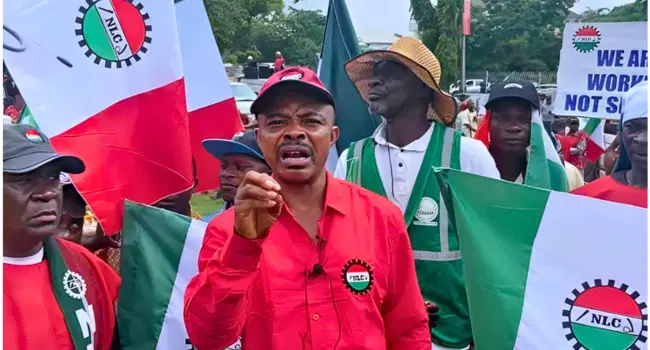
The Nigeria Labour Congress, NLC, has backed the demand by civil servants for a new national minimum wage of N500,000 and a reduction in petrol prices to N500 per litre, citing the worsening cost-of-living crisis.
The demand was contained in a letter to President Bola Tinubu signed by the National Secretary of the Joint National Public Service Negotiating Council, JNPSNC, Trade Union Side, Olowoyo Gbenga.
The workers also called for the immediate establishment of a committee to negotiate a new national minimum wage ahead of January 2027.
The JNPSNC gave the Federal Government until Wednesday, September 30, 2026, to respond to the demands, warning that rising economic hardship was creating tension among workers and the wider population.
According to the council, petrol prices have risen to N1,430 per litre or higher in some parts of the country, worsening the cost of transportation and other essential goods.
The JNPSNC comprises several public-sector unions, including the Nigerian Civil Service Union, Medical and Health Workers Union, Association of Senior Civil Servants of Nigeria, National Association of Nigerian Nurses and Midwives, Amalgamated Union of Public Corporations, Civil Service Technical and Recreational Employees, Nigeria Union of Public Service, Reportorial, Secretarial, Data Processors and Allied Workers, National Union of Printing, Publishing and Paper Products Workers, and National Union of Agriculture and Allied Employees.
The council said the removal of the fuel subsidy three years ago had contributed to a sharp rise in petrol prices, with the impact spreading to food, transportation and other areas of the economy.
It also argued that government-distributed food palliatives were not a sustainable response to the economic difficulties facing Nigerians.
Instead, the workers proposed reducing petrol prices to N500 per litre, arguing that cheaper fuel would have a wider economic impact and provide relief to households and businesses.
Workers seek intervention on fuel prices
The JNPSNC urged the Federal Government to intervene in the fuel market and stabilise pump prices at an affordable level.
It also proposed the establishment of an intervention fund involving stakeholders in the oil sector, with the aim of bringing petrol prices down to N500 per litre.
The council said the intervention could be given another name if government was unwilling to describe it as a fuel subsidy.
It also backed a position attributed to NLC President Joe Ajaero, who argued that Nigeria, as an oil-producing country, should have some protection against international oil-price shocks.
The NLC position called for government to make sufficient crude oil available in naira to domestic refineries, while also expanding national storage capacity to strengthen energy security.
According to the position cited by the council, such measures could support job creation, generate economic value and address some security challenges.
The NLC also maintained that government could provide support for citizens during emergency periods, noting that oil-producing countries have adopted different forms of intervention during difficult economic periods.
On government revenue, the NLC position stated that Nigeria was earning between 35 and 40 US dollars per barrel above the budgeted crude oil price on the international spot market, translating into significant monthly revenue.
The labour body also raised concerns about domestic refineries importing crude oil, describing the situation as inconsistent with the objective of developing local refining capacity.
Wage award demanded for workers
On salaries, the JNPSNC called for an immediate wage award covering workers at the federal, state and local government levels.
It also demanded an upward review of salaries and allowances for serving public servants.
Under its proposed 2027 salary structure, the council wants an officer on Grade Level 01, Step 1, to receive a minimum monthly salary of N500,000.
The council further called for harmonised wages across ministries, departments and agencies, MDAs, while encouraging similar reviews at the state and local government levels.
It urged President Tinubu to direct the National Salaries, Incomes and Wages Commission, NSIWC, to begin negotiations with the NLC, Trade Union Congress of Nigeria, TUC, JNPSNC, and other relevant stakeholders.
NLC says demands are legitimate
The Nigeria Labour Congress has expressed support for the civil servants’ demands, describing the proposed wage award and reduction in petrol prices as realistic and long overdue.
The NLC Acting General Secretary, Benson Upah, told Vanguard that workers’ earnings had remained relatively unchanged while inflation continued to reduce their purchasing power.
He said the rising cost of petrol was affecting workers’ ability to commute to work and provide for their families.
Upah added that increases in fuel prices have broader consequences because they affect the cost of essential goods, transportation and school fees.
He stressed that the economic difficulties were affecting not only workers but also other Nigerians, particularly low-income households.
The NLC therefore urged the Federal Government to take urgent action on the workers’ demands.
Source: Vanguard
