

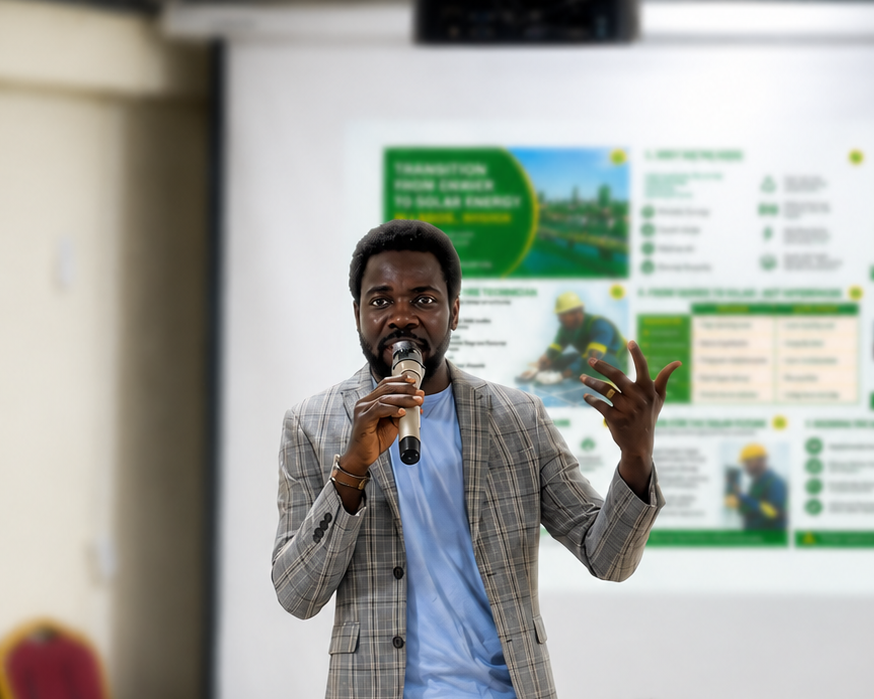
LAGOS, Nigeria — The transition from petrol- and diesel-powered generator sets to solar energy in Lagos presents significant opportunities for job creation, economic development and environmental sustainability, but the success of the transition will depend largely on the availability of properly trained technicians, researcher Dr Eghosa Igudia has said.
Igudia made the remarks during a town hall meeting organised as part of a research programme examining the transition from generator sets to solar energy in Lagos.
The programme is linked to the African Cities Research Consortium (ACRC), a multi-country research initiative focused on generating evidence and knowledge on how African cities can achieve inclusive development, attract investment, strengthen governance and reduce poverty.
According to Igudia, the Lagos solar-energy study is designed not only to examine the growing adoption of solar technology but also to understand the experiences, skills, challenges and training needs of technicians working in the sector.
He said the research, which began with fieldwork on July 1, was intended to generate evidence that could support policies and interventions capable of accelerating the shift towards cleaner and more reliable energy sources.
Four conditions for urban transformation
Explaining the thinking behind the research, Igudia said the work draws on a model of urban transformation built around four key conditions: political commitment from elites, formal reform coalitions, citizens mobilised to demand change, and institutions capable of building both short- and long-term state capacity.
He said these conditions work together to create the environment required for meaningful development and poverty reduction.
“At the heart of this is the people, the citizens,” he said, stressing that citizens could have considerable influence when they organise around common concerns and articulate their demands collectively.
According to him, the research approach combines political and systems analysis, examination of donor interventions and city policies, and action research aimed at generating practical solutions.
He emphasised that technicians and other citizens involved in the energy sector were not merely research subjects but important participants in generating the knowledge required to improve the sector.
Rising demand for alternatives to generators
Igudia said the need for alternative energy sources was particularly urgent in Lagos because of the city’s enormous energy demand and the persistent inadequacy of electricity supply.
He noted that businesses, households, schools, hospitals and other institutions depend heavily on alternative sources of electricity to maintain their operations.
Nigeria’s long-standing dependence on generator sets, he said, has resulted in high energy costs, noise pollution and other environmental and economic challenges.
The increase in the cost of fuel following the removal of petrol subsidy has further intensified the financial burden on households and businesses that rely on generators.
Igudia argued that the circumstances make the search for a cheaper, more sustainable and environmentally friendly energy source increasingly important.
Solar energy, he said, offers considerable potential because Nigeria receives abundant sunlight that can be harnessed to generate electricity.
However, he cautioned that the transition should not be treated as a simple matter of installing solar panels.
Poor technical skills pose major challenge
According to the researcher, some Nigerians have had negative experiences with solar installations, including poorly installed systems, equipment failures and safety incidents.
Such experiences, he warned, could undermine public confidence in solar energy if they are not properly addressed.
He identified inadequate technical skills as one of the major challenges confronting the sector.
Igudia said the early expansion of the solar industry had, in some instances, involved technicians receiving limited training before passing knowledge on to others.
The result, he suggested, was a chain of technicians with varying levels of expertise and, in some cases, insufficient knowledge to safely install, maintain and troubleshoot modern solar systems.
He therefore called for greater emphasis on professional training, retraining, certification and adherence to installation standards.
“Your role is crucial,” Igudia told technicians participating in the town hall. “You play a pivotal role in this chain.”
He said the quality of technicians would ultimately influence public confidence in solar technology and determine whether the sector could expand sustainably.
Solar sector already creating jobs
Igudia also highlighted the employment potential of the renewable-energy sector.
Preliminary findings from the survey of technicians indicated that many solar businesses employ between three and five people, despite a significant proportion of respondents describing themselves as self-employed.
He said this demonstrated that self-employment in the sector was not necessarily a one-person operation, as business owners were already creating employment opportunities for others.
The researcher said the trend could grow significantly if the sector received the appropriate support, particularly in the areas of technical training, standards and market development.
“Solar energy has huge opportunity. There’s massive opportunity. It creates jobs,” he said.
He added that developing the skills of technicians would be essential to ensuring that the employment and economic benefits of the sector were fully realised.
Opportunity to retrain generator technicians
The research also examined the possibility of transferring skills from the generator-repair sector to the emerging solar industry.
Igudia said many Nigerians had acquired technical experience through years of working with generator sets and electrical systems.
Rather than allowing such workers to become economically displaced as the country gradually moves towards renewable energy, he said they could be retrained to work as solar technicians.
He described the retraining of generator technicians as an important part of ensuring a “just” and inclusive energy transition.
“If they are to be able to do well as solar technicians, they need to be trained. They need to be retrained,” he said.
According to him, successful reskilling would help create a productive workforce capable of earning sustainable incomes while meeting the growing demand for solar services.
Safety and standards
Beyond skills development, Igudia stressed the importance of proper installation and compliance with technical standards.
He said poorly executed installations could result in safety risks, equipment damage and loss of confidence among consumers.
He also acknowledged concerns over the proliferation of substandard solar equipment but argued that the challenge could be addressed through stronger regulation and enforcement.
In his assessment, however, inadequate technical capacity represented a deeper and more difficult challenge because even quality equipment could become dangerous or ineffective when installed or maintained by inadequately trained personnel.
Research enters stakeholder engagement phase
Igudia said the research was being conducted in phases.
The first phase involved administering questionnaires to technicians across different parts of Lagos. The second phase involves interviews with selected participants and stakeholders, while the third phase involves town hall discussions and broader stakeholder engagement.
The first phase of fieldwork ran from July 1 to August 4, while interviews were continuing alongside the stakeholder engagement activities.
A total of 318 technicians participated in the questionnaire exercise.
Igudia said the research team was using the town hall meeting to present findings from the first phase, obtain feedback from technicians and gather additional insights that could help shape subsequent stages of the research.
The wider stakeholder engagement is expected to bring together technicians, policymakers and other actors in the renewable-energy ecosystem.
Building the solar market together
The researcher said the purpose of the town hall was therefore not simply to present research findings but to create a platform where technicians could exchange experiences, identify common challenges and articulate their training and certification needs.
He said participants would also have an opportunity to learn from one another about successful practices and explore ways of strengthening collaboration within the sector.
Igudia described the process as one of “feedback and feedforward”, in which researchers would present what they had learned while technicians would provide practical responses, corrections and additional information based on their experiences.
He said the ultimate objective was to develop a stronger ecosystem for solar energy in Lagos by ensuring that the people installing and maintaining the technology had the skills required for the future.
The transition from generator sets to solar energy, he noted, should therefore be viewed not only as an energy-sector transformation but also as an opportunity for skills development, job creation, improved livelihoods, environmental sustainability and inclusive urban economic development.
While detailed statistics and findings from the technicians’ survey were presented during the research session, the research team indicated that specific data and findings were confidential and should not be publicly disclosed at this stage.
Igudia said the ongoing research would continue to engage technicians and other stakeholders as the team works towards producing evidence that can inform policies and programmes for a sustainable solar-energy transition in Lagos.
