

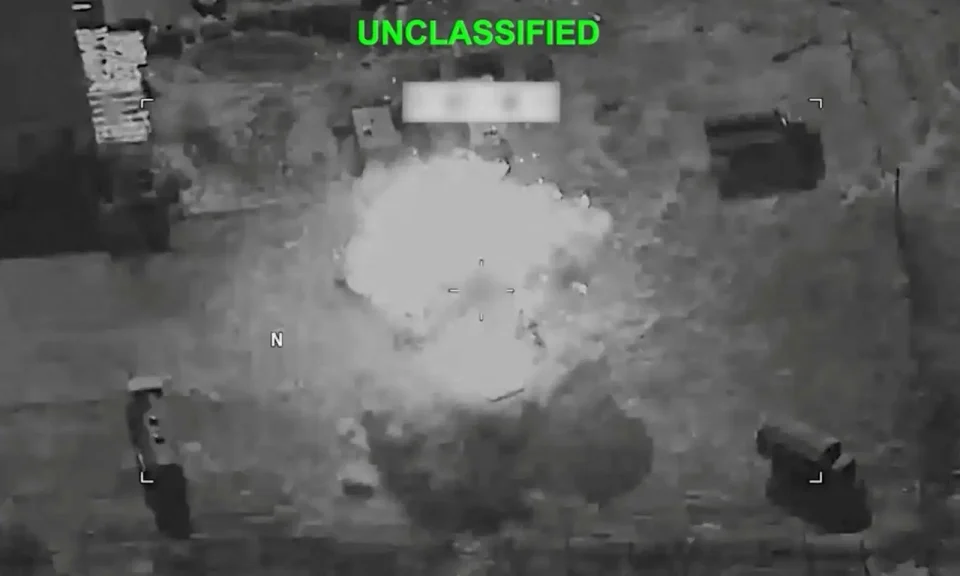
The United States military said it had completed a “heavy wave of strikes” against Iran on Thursday, in response to Tehran’s missile attack on American military bases in Jordan, as renewed fighting deepened tensions across the Middle East.
According to the US Central Command (CENTCOM), American forces targeted dozens of sites linked to Iran’s Islamic Revolutionary Guard Corps (IRGC), including military command centers.
The latest escalation came after President Donald Trump vowed that the United States would respond forcefully to Iran’s strike on Jordan, which was described as Tehran’s first regional missile attack in several days.
Iran’s state news agency IRNA reported that multiple locations in Khuzestan province in southwestern Iran were hit, along with targets on Qeshm Island in the Gulf.
Provincial authorities said areas around Abadan, Shadegan, Arvandkenar and Ahvaz were among those affected.
The renewed confrontation has drawn in Iran’s regional allies and appears to have reduced hopes for a quick return to negotiations between Washington and Tehran.
In a further sign of the widening conflict, Saudi Arabia and the United States announced joint strikes on militant bases in Iraq on Wednesday, while Israel accused the Iran-backed group Hezbollah of violating a ceasefire.
Saudi Arabia, the world’s largest oil exporter, said its crude facilities had been targeted by drone attacks for two consecutive days and blamed Iraqi armed groups aligned with Tehran.
Jordan’s military said it intercepted five Iranian missiles, after the IRGC announced that it had targeted US bases inside the kingdom.
The IRGC declared that resistance would continue as long as threats against Iran persisted.
Israel also accused Hezbollah of launching a drone overnight at an Israeli vehicle inside Lebanon, calling it a clear breach of the ceasefire.
Although Israel fought alongside the United States during the early phase of the war with Iran, it has not joined the latest round of strikes.
In Iraq, the joint US-Saudi operation targeted what Washington described as logistics and weapons facilities belonging to an Iran-aligned armed group.
Iraq’s Hashed al-Shaabi, or Popular Mobilisation Forces, said at least 20 of its members were killed and condemned the strikes as a “dangerous escalation” against an official security institution.
Two Hashed officials also claimed that five Iranian advisers were among the dead.
The Iraqi government denounced the strikes and said it rejected all acts of aggression regardless of who carried them out.
The Ministerial Council for National Security said Iraq would confront any violation of its sovereignty and prevent its territory from being used to threaten neighboring countries.
However, Fox News reported that President Trump said the operation had been coordinated with the Iraqi government.
The latest developments come amid growing US pressure on Baghdad to disarm pro-Iran armed groups.
Attention has also shifted to the Strait of Hormuz, where Iran has maintained restrictions on shipping during much of the conflict.
Iran’s Revolutionary Guards said on Wednesday that they had intercepted and stopped three tankers in the strait and insisted that Tehran has full control of the strategic waterway.
Iran has also announced plans to impose fees on vessels passing through the strait, a move opposed by Washington.
Oil prices fell slightly on Thursday after rising sharply the previous day.
The United States has also announced new sanctions targeting entities linked to the IRGC, accusing them of extorting ships transiting the Strait of Hormuz.
