

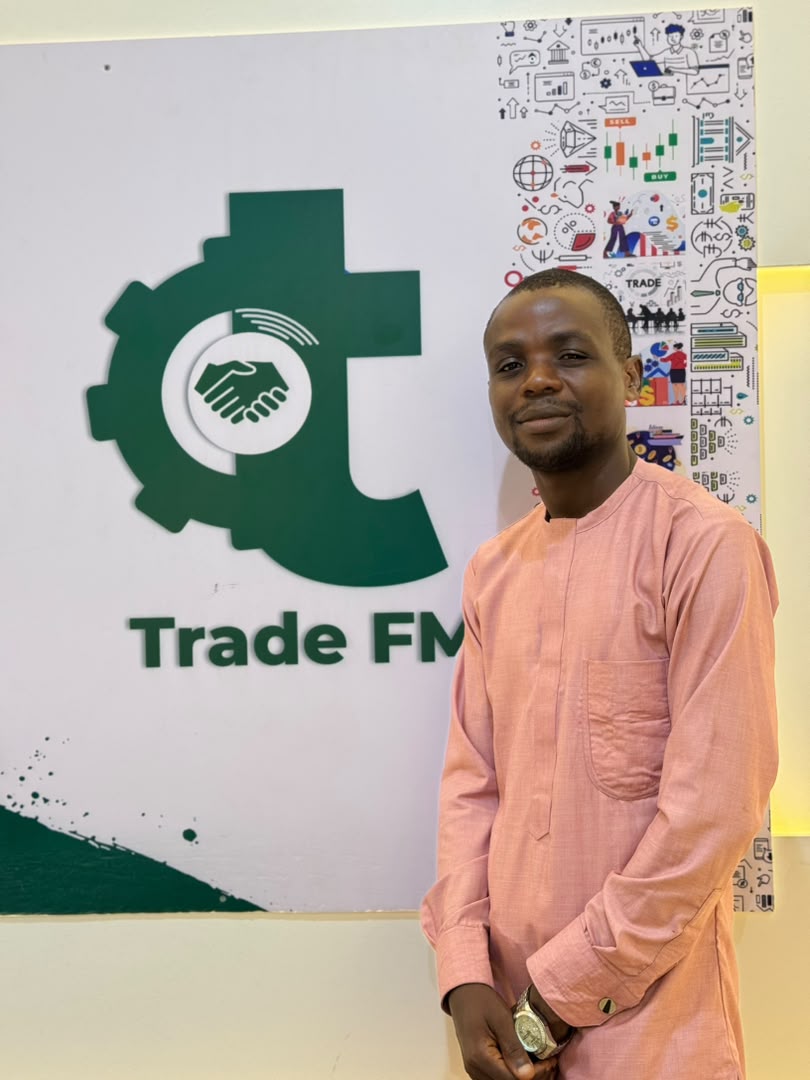
The Founder and Chief Executive Officer of Gbendan Company Limited, Mr Gbenga Daniel Oladimu, has called for greater investment in indigenous agricultural products, stressing the need for improved processing, quality assurance and technology adoption to make Nigerian food commodities more competitive in local and international markets.
Oladimu made the call while speaking on the SME segment of Trade FM’s Breakfast Business Briefing, where he discussed the company’s journey, its contribution to agricultural value addition, export opportunities and the introduction of its artificial intelligence-powered food traceability initiative, Gbendan Trace AI.
The entrepreneur explained that Gbendan Company Limited began as a business enterprise focused on agricultural produce and value addition before transitioning into a limited liability company in 2025.
He disclosed that the company’s name was derived from the combination of his first two names, Benda and Daniel, as part of a vision to establish a lasting business legacy.
According to him, the company was established not only to generate income but also to promote Nigerian food culture and demonstrate the commercial potential of indigenous agricultural commodities.
He said the decision to concentrate on products such as Ofada rice, Ijebu garri and unripe plantain flour was informed by the need to change the perception that foreign products are superior to locally produced alternatives.
Oladimu said, “We Africans and Nigerians are the ones who can tell our stories ourselves. If you look at many countries, you will see their peculiar food that they actually eat. But when we look at Nigeria, most of the time, we do not regard Nigerian products as important. We do not prioritise them.
“We bring in foreign products and think they are always bigger, while we look at Nigerian or African products as inferior. So, we are trying to promote our culture, tell our stories and demonstrate that there is commercial value in these products.”
Quality assurance and value addition
The Gbendan Company chief executive stressed that transforming indigenous agricultural produce into internationally competitive products requires more than attractive packaging, noting that proper processing, sourcing of raw materials and adherence to regulatory standards are essential.
He explained that the company maintains standard operating procedures throughout its production processes to ensure consistency and protect consumer confidence.
According to him, all the company’s products are registered with the National Agency for Food and Drug Administration and Control (NAFDAC), a development he said strengthens its credibility and improves its chances of competing in international markets.
“The raw material is as important as the finished product itself. It is not about getting a product from anywhere, perhaps from the general market or a farmer, and packaging it because you want to make money. It is about following the right processes.
“What makes us unique is consistency, adherence to standard operating procedures and undergoing the necessary regulatory processes. All our products are NAFDAC-registered and approved,” he said.
Oladimu identified inadequate government support for farmers, post-harvest losses and limited value addition as some of the major challenges confronting Nigeria’s agricultural sector.
Reflecting on agricultural policies, he referenced the Agricultural Transformation Agenda introduced during the tenure of former Minister of Agriculture, Dr Akinwumi Adesina, describing it as an intervention that helped empower rural farmers.
He, however, expressed concern over what he described as the absence of sufficiently impactful agricultural policies capable of strengthening farmers and supporting agribusiness development.
The entrepreneur, who studied Agricultural Economics and Extension at the University of Benin, also advised young Nigerians interested in agribusiness to understand the commercial realities of their proposed ventures before investing.
He cautioned that having a business idea does not automatically translate into profitability.
“A business might be viable but not profitable. You must understand what you want to do and how to get it right. Many people have an idea that they want to start plantain farming, for instance, and they just go into the business without understanding the processes. At the end of the day, the way you go into the business is the way you rush out,” he said.
Exports, bulk supply drive business growth
Speaking on the company’s distribution channels, Oladimu said Gbendan serves different market segments, including individual consumers, retailers, wholesalers, supermarkets and corporate clients through bulk supplies and corporate hampers.
He described the different channels as complementary but identified bulk purchases and exports as major opportunities for expanding the company’s operations.
According to him, the company has already commenced exports and is seeking additional international customers.
He disclosed that it is registered with the Nigerian Export Promotion Council (NEPC) and has obtained the necessary documentation to facilitate its export activities.
“Export is a win-win for us because we have done the necessary things. We are registered with the Nigerian Export Promotion Council, and we have all the documents required. We can get them as quickly as possible, including for other people who want to export our products,” he said.
Oladimu also explained the production process for the company’s unripe plantain flour, stating that the company handles the process from the sourcing of raw materials to the final packaging.
He said the plantains are mechanically peeled, washed, sliced and dried, either under sunlight or with industrial dehydrators, depending on production timelines and customer demand.
He noted that dehydrators are particularly useful when orders must be fulfilled quickly.
The founder further highlighted moisture control as a critical aspect of processing, explaining that the company targets moisture content of between 12 and 14 per cent to minimise the risk of spoilage and ensure the product remains suitable for storage and export.
He said the company is particularly careful about maintaining product purity because its unripe plantain flour is consumed by health-conscious individuals and people managing diabetes.
Explaining why the product is relatively expensive, Oladimu disclosed that processing results in a significant reduction in the weight of the raw material.
He recalled an early production experiment in which 25 kilogrammes of fresh plantain yielded approximately four kilogrammes of finished flour after peeling, slicing and drying.
“The product is expensive because of what it passes through. When we started producing plantain flour, we experimented with about 25 kilogrammes of plantain. After peeling and processing, what we got as the final product was around four kilogrammes.
“That is why, if you really want the original product, you must be willing to pay the price and the premium. We try as much as possible not to dilute the product because we are not only building a business; we are also building a name. Trust is the social capital we need in this business,” he said.
Rising production costs and supply chain challenges
On the impact of inflation and rising food prices on the company’s operations, Oladimu said the business adopts several cost-reduction strategies to maintain profitability and product availability.
He identified bulk purchasing of raw materials, efficient logistics, timely processing and direct relationships with farmers as some of the measures used to manage production expenses.
According to him, purchasing agricultural produce in larger quantities helps reduce transportation and logistics costs, while maintaining relationships with trusted farmers provides more reliable access to raw materials.
He explained that agricultural production is also affected by seasonal variations and unpredictable weather conditions, making proper planning and supply chain management essential.
“For you to maximise profit or even make money, you must be able to minimise cost. When you buy raw materials in large quantities, the amount you spend on logistics may almost be the same whether you are transporting a few pieces or a much larger quantity.
“We also aggregate farmers and establish direct relationships with them. It is not about going to the farm or market randomly to purchase products. We work with farmers who trust us and whom we also trust. This makes the process easier,” he said.
He further identified inadequate storage facilities as another major challenge for agricultural businesses, particularly during the rainy season, when weather conditions can affect harvesting, processing and the preservation of raw materials.
Gbendan Trace AI targets food safety and transparency
A major highlight of the interview was the company’s introduction of Gbendan Trace AI, an artificial intelligence-powered initiative designed to improve food safety, transparency and traceability across Nigeria’s agricultural value chain.
Oladimu said the initiative was developed to enable consumers to obtain reliable information about the food they purchase, including its origin, production history and safety status.
He explained that the technology would allow consumers to scan a QR code on product packaging to access information such as the state where the agricultural produce originated, the farmers involved, batch numbers and production dates.
He said the platform would also provide information about whether products are genetically modified, allowing consumers to make purchasing decisions based on their preferences.
“The three main goals of Gbendan Trace AI are food safety, transparency and traceability. Everybody needs to eat good food, but people must also be able to determine what they are consuming.
“What we are trying to achieve is that when you buy a premium product, you should be able to determine whether that product is safe. You should also know where the food originated from and be able to trace its journey,” he said.
Using garri as an example, the entrepreneur explained that the technology would help distinguish Nigerian products from similar commodities produced in other countries, particularly in international markets.
He cited a conversation with a customer in Maryland, United States, who observed that Caribbean countries also produce food products similar to those made in Nigeria.
According to him, traceability technology would help establish the identity and origin of Nigerian products, making it easier for international buyers to verify their authenticity.
He said, “You should be able to scan the QR code and see that this particular garri came from Ogun State. You should be able to identify the farmers, know where it came from, the batch number and the period of production. Everything will be captured.”
Addressing concerns about the accessibility of digital technology among smallholder farmers, Oladimu said the company was exploring the use of Unstructured Supplementary Service Data (USSD) and offline solutions.
He explained that the approach would enable farmers without internet access to retrieve product records by entering a code, thereby ensuring that the innovation does not exclude rural agricultural communities.
AI adoption and consumer protection
Oladimu maintained that artificial intelligence and digital technology would become increasingly important to agricultural development, insisting that Nigerian businesses must embrace innovation to remain competitive.
He said Gbendan Trace AI was being developed to provide consumers with additional information about food products beyond conventional labelling, including manufacturing dates, batch numbers and best-before dates.
He also explained that the company’s approach to food safety includes withdrawing products from circulation when they reach the end of their recommended best-before period.
Clarifying the distinction between food labelling and pharmaceutical labelling, he noted that food products commonly carry manufacturing dates and best-before dates rather than the expiry-date labels typically associated with medicines.
According to him, the traceability initiative is intended to strengthen consumer confidence by making product information more accessible and transparent.
Oladimu added that the company was still developing the broader capabilities of the technology, noting that Gbendan Trace AI would incorporate additional features aimed at improving food safety and accountability.
He expressed optimism that the innovation could contribute to reducing food-related health risks by helping consumers make more informed decisions about the products they purchase and consume.
The entrepreneur also reiterated the importance of promoting locally produced foods, arguing that Nigerian agricultural commodities have significant potential to compete globally when supported by proper processing, regulatory compliance, reliable supply chains and technology.
He maintained that building consumer trust, preserving product quality and strengthening the identity of Nigerian agricultural produce would remain central to Gbendan Company Limited’s long-term vision.
