

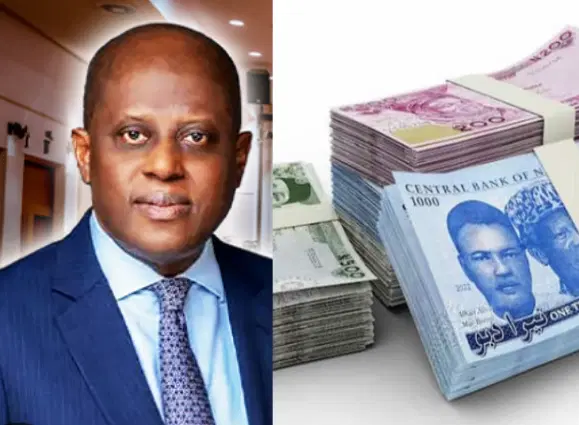
The Federal Government recorded a fiscal deficit of N4.69 trillion in the first quarter of 2026, following a significant shortfall in revenue generation, raising concerns about funding the country’s annual budget.
This came despite Nigeria’s economy recording a real-term growth of 3.89 per cent during the same period, supported by improved performance in both the oil and non-oil sectors.
Figures contained in the 2026 Budget Performance Report released by the Budget Office of the Federation showed that the government’s fiscal deficit stood at N4.69 trillion, compared with the prorated target of N7.86 trillion for the January to March period.
This represented a difference of N3.18 trillion below the projected deficit.
The report also revealed that total Federal Government revenue amounted to N5.08 trillion, significantly below the quarterly target of N9.22 trillion, leaving a revenue shortfall of N4.14 trillion.
Government expenditure during the period stood at N9.76 trillion, compared with the projected N17.08 trillion. This indicated an underperformance of N7.32 trillion, representing approximately 57.2 per cent of the target.
On deficit financing, domestic borrowing amounted to N3.9 trillion, against the projected N4.61 trillion, resulting in a shortfall of N704.03 billion.
Foreign borrowing also recorded no actual inflows during the quarter, despite a target of N2.70 trillion.
Meanwhile, the government generated N287.44 billion from multilateral and bilateral project-linked loans, compared with the expected N512.23 billion.
Proceeds from privatisation stood at N3.32 billion, significantly below the projected N47.29 billion.
The figures highlight the difficulties facing the government in meeting its revenue expectations and securing the financing required to implement the 2026 budget.
Nigeria’s economy grows by 3.89%
On economic performance, the Budget Office reported that the oil sector expanded by 2.57 per cent in real terms year-on-year during the first quarter of 2026.
This represented an improvement of 0.70 percentage points from the 1.87 per cent growth recorded in the corresponding period of 2025.
The non-oil sector performed better, recording a growth rate of 3.94 per cent and contributing a larger share to the country’s overall economic expansion.
The Budget Office characterised the period as one of macroeconomic stabilisation accompanied by moderate growth in productive economic activities.
However, it identified weak revenue generation, despite some improvement, as a major obstacle to effective budget implementation.
The office noted that the Federal Government had continued to meet its mandatory expenditure obligations but stressed that stronger revenue collection in subsequent quarters would be necessary to successfully implement the 2026 budget.
It also disclosed plans to intensify efforts to improve economic growth and government earnings while keeping recurrent expenditure, particularly personnel costs, under control.
Among the strategies identified to strengthen the economy were increased oil production, expansion of the tax base, improved tax compliance, stronger domestic production, higher agricultural productivity, infrastructure development, improved access to private-sector credit and diversification of exports.
The Budget Office stressed that the major challenge for the remainder of 2026 would be converting macroeconomic stability into increased productive capacity and stronger domestic revenue generation.
It further explained that sustaining progress in inflation management, exchange-rate stability and the external sector would require creating more opportunities for private-sector investment, productive lending and employment generation.
The report also highlighted the need to manage recurrent spending and address security challenges to improve the country’s overall fiscal position.
On budget implementation, the Budget Office reaffirmed the government’s commitment to transparency and accountability, promising strict compliance with budget implementation guidelines and the monitoring framework for capital projects.
It added that attention would be directed towards improving the efficiency of budget execution and ensuring proper management of government projects during the remaining quarters of 2026.
Source: VANGUARD
