

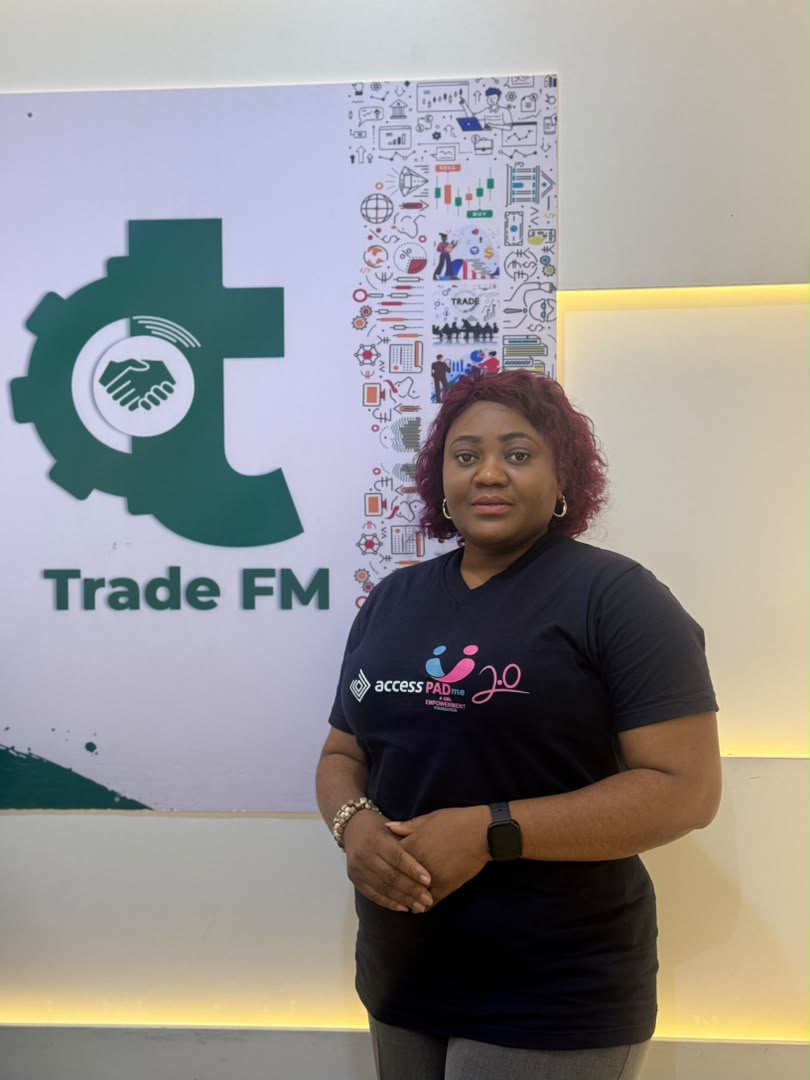
The founder of the Pad Me A Girl Empowerment Foundation, Theresa Moses, has urged the government to establish free sanitary pad banks in schools, hospitals and communities across Nigeria to tackle period poverty and prevent girls from missing school because of a lack of menstrual hygiene products.
Moses made the call during an interview on the Ask the Expert segment of Trade FM’s Breakfast Business Briefing, where she highlighted the challenges faced by girls and women who cannot afford sanitary pads, particularly those in internally displaced persons (IDP) camps and economically disadvantaged communities.
She said menstrual health should be treated as a basic need rather than a privilege, stressing that the inability to afford sanitary products continues to undermine girls’ education, health and confidence.
“Period poverty is a mother trying to choose between buying a pad and feeding her child. Period poverty is, at this time that we are, there are still people who can’t afford sanitary pads,” she said.
According to her, the problem affects not only adolescent girls but also married women and mothers who must prioritise food and other household necessities over menstrual hygiene products.
“The painful part of it is that we are here in Lagos, in other cities. There are people out there in Nigeria, in this present day, that cannot afford a sanitary pad. Young girls and even mothers that are married, that have children, they can’t afford sanitary pads because they have the option of using that money for sanitary pads to feed.
“So sanitary pad is not on the table. That is what period poverty is,” she added.
Moses described the situation as particularly troubling because some girls are forced to miss school during menstruation, while others resort to using rags and newspapers because they cannot afford sanitary pads.
“Period poverty is a girl in her brightest, missing school because she can’t afford sanitary pads. She uses rag. That is period poverty. At this age, she uses rag, uses newspapers. Tissue paper is even a luxury where they are,” she said.
She warned that the inability to access menstrual hygiene products could expose girls and women to health risks while reinforcing the stigma and silence surrounding menstruation.
“At this age and time, girls are having infections and they can’t speak out because of stigmatisation. At this time, we still feel that menstrual health is a privilege for a few,” Moses said.
How school experiences inspired the foundation
Moses traced the motivation behind the foundation to her childhood experiences in Plateau State, where she observed that some of her female classmates regularly missed school because they could not afford sanitary pads.
She explained that although her family was not wealthy, she had access to menstrual hygiene products when she began menstruating at the age of 13.
“I was born and raised in Plateau State, to be specific. My parents are not wealthy, but we are comfortable. I had access to sanitary pads. When I started my menstruation at 13, my mum bought a popular sanitary pad for me, and I didn’t use tissue. So I started with sanitary pads,” she said.
However, her experience in a government school exposed her to the difficulties faced by girls from less privileged backgrounds.
“I realised that a lot of people there, a lot of girls, used to miss school. And when I asked why they were not in school, they would just tell me that it was the month, it was their period, and they couldn’t afford sanitary pads,” she said.
According to Moses, the girls would remain at home during menstruation and return to school after several days, often missing important lessons and school activities.
She said the experience left a lasting impression on her and inspired her to help girls facing similar challenges when she eventually had the resources and opportunity to do so.
“That stung inside of me, and I said that when I get to that point where I become an adult and have resources and the opportunity, I will definitely do something about it,” she said.
Moses, who is also a journalist, initially implemented the intervention as part of her organisation’s corporate social responsibility activities before expanding it into a registered foundation.
“I didn’t actually start it as a foundation. I started it as a CSR of my organisation as a journalist. It then metamorphosed into a foundation because we realised that the thing I had in my head was beyond me. It was bigger than me and bigger than my own organisation,” she said.
She explained that the need to attract broader support and partnerships led to the establishment of the foundation as a formal platform for reaching more girls and women.
Foundation establishes free pad banks in three locations
As part of its efforts to address period poverty, Moses said the foundation had established three major pad banks in IDP camps across the Federal Capital Territory, Benue State and Nasarawa State.
She identified the locations as an IDP camp in the FCT, Ocheci IDP camp in Benue State and Kadomko IDP camp in Nasarawa State.
According to her, the pad banks operate as designated centres where sanitary pads are stored and made available free of charge to girls and women who need them.
“The Pad Bank is not a one-off thing. It’s a centre where we stock pads. So we have partners, like Amiri, Access Pad. Access supported us, so we got pads and stored them in a bank, which is why it is called Pad Bank,” she said.
Moses stressed that the initiative was not designed as a commercial venture, adding that beneficiaries did not have to pay for the products.
“It’s free. Yes, the Pad Bank is free. It’s not for sale. Our sticker is on it,” she said.
She explained that beneficiaries provide basic details, including their names, to enable the foundation to monitor access, maintain records and follow up on their needs.
The foundation also maintains communication with beneficiaries through youth committees in the camps, allowing girls and women to report challenges or concerns about the distribution process.
“So anybody in the camp who is on their cycle, they go there. There’s documentation, so that things will not just happen anyhow. They go there, put down their names and take their pads,” she said.
Moses disclosed that the foundation currently purchases sanitary pads from the market with support received from corporate organisations and other partners.
She named First Line International, Bayer Consulting and Access among the organisations that have supported its activities.
She added that the foundation intends to expand the pad bank initiative beyond the three locations but requires more financial resources and partnerships to achieve its goal.
“We intend to expand, but it’s money. We need to expand, but then we still do partnerships with other individuals and schools that need them, so we go to schools and distribute,” she said.
“The long-term project of Pad Bank is to have a Pad Bank in every school, every community, everywhere. There should be access to free sanitary pads.”
Beyond pad distribution: Menstrual health education
Moses said the foundation’s intervention extends beyond providing sanitary pads, noting that beneficiaries also receive education on menstrual health, personal hygiene and the proper use and disposal of menstrual products.
She explained that the foundation works with health practitioners to educate girls on how to care for themselves during menstruation, maintain personal hygiene and recognise when to seek medical attention.
“We don’t focus on the whole distribution. When we started, we had three pad banks in three major states, the FCT area, Benue State and Nasarawa State. So what we do is stock pads there, but we don’t just leave them like that,” she said.
“We go as far as creating menstrual health awareness. We bring in health practitioners to talk to them about their menstrual health and personal hygiene.”
She said the education includes guidance on keeping underwear clean, changing menstrual products regularly and maintaining a healthy diet.
According to her, the foundation also encourages girls to eat nutritious meals, even when their families have limited resources.
“When you are not healthy, when you are not eating well, you will feel weak. So we tell them that no matter what resources you have, no matter whatever you have, you can make your food healthy. You can make it rich,” she said.
“Whatever you’re eating, if it is rice and beans, you add vegetables to it. It’s going to be rich.”
Moses added that the foundation sometimes provides food items to beneficiaries because menstrual hygiene interventions cannot be separated from the wider problem of poverty and food insecurity.
She disclosed that Chevron had supported one of the foundation’s food distribution activities.
“We go as far as giving them food items, because we are talking to a hungry person. Definitely, you have to consider their immediate needs as well,” she said.
She further explained that the foundation was exploring ways to extend its support to include relevant healthcare assistance for beneficiaries experiencing menstrual discomfort, alongside its existing pad bank activities.
Community engagement to challenge stigma and early marriage
Moses said the foundation also engages community leaders, religious leaders, parents and boys to challenge harmful attitudes towards menstruation and encourage girls to remain in school.
She noted that in some communities, the onset of menstruation is interpreted as a sign that a girl is ready for marriage, a perception that can expose young girls to early marriage and teenage pregnancy.
According to her, economic hardship can compound the problem when parents struggle to provide sanitary pads for several daughters.
She argued that improving access to menstrual products, alongside addressing food insecurity and other economic difficulties, could help reduce the pressure that pushes some families towards early marriage.
“Many people cannot afford to get sanitary pads. Maybe you have three girls, and they are in the same age of puberty, and you can’t afford it. What do you do?” she asked.
She added that some parents might view marriage as a way of transferring the responsibility of providing for their daughters to their husbands.
“If there is access to sanitary pads, no mother or father will want to send their daughter into early marriage,” Moses said.
She stressed, however, that the foundation does not approach communities by condemning their cultural beliefs. Instead, it seeks to establish relationships with community leaders and explain the importance of girls’ education and menstrual health.
“Any community we go to, we make them a friend. We don’t just go there, distribute and go. We reach out to the community leaders and tell them our mission of coming here, not to change the culture that you believe in, not to say you’re wrong, not to condemn your belief,” she said.
“But what we want you to understand is that the girl child has a right to go to school.”
Moses said the foundation also provides educational materials, including books, exercise books and pens, to encourage school attendance and help girls acquire basic literacy skills.
She explained that education gives girls greater opportunities to understand information about healthcare, government programmes and other services available to their communities.
“We are now educating them to allow their girls to go to school, to at least read and write,” she said.
She added that the foundation encourages girls to speak openly about menstrual health concerns rather than remain silent because of cultural or religious stigma.
“We educate them to understand that menstruation is a normal, natural thing. We understand if you can’t afford it because of the economy, but we have access to these pads. So let them have them and let them go to school, too, while they are on their period,” she said.
“We listen to them first, and then we encourage and advise. We don’t condemn their beliefs.”
Men and boys encouraged to participate
The founder said the foundation deliberately includes boys and men in its awareness campaigns because they can influence how girls experiencing menstruation are treated at home, in school and within their communities.
She noted that some boys stigmatise girls who begin menstruating, making it important to educate them about menstrual health and discourage discriminatory attitudes.
Moses also disclosed that men had played a significant role in supporting the foundation’s work.
“Funny enough, this drive has been supported basically by men. Men have always been doing this,” she said.
She added that the foundation encourages girls to continue participating in education and recreational activities, including sports, during menstruation.
According to her, the message is intended to reassure girls that menstruation should not prevent them from pursuing their interests or participating in normal daily activities.
Founder highlights impact of the intervention
Moses said the foundation measures its impact partly through feedback from beneficiaries and the changes it observes in their confidence, menstrual hygiene practices and commitment to education.
She recalled that when the foundation first visited an IDP camp in Abuja, some residents were sceptical because they had encountered interventions that involved distributing items once without returning.
She said she reassured them that the foundation intended to maintain a relationship with the community and continue providing support whenever resources and partners were available.
“What gives us the most joy is that we listen to them. I see all the videos. I would like you to listen to them in the Hausa language, where they say they are happy that when we came, they thought we would not return, but they are happy that we did not only stop at giving them pads,” she said.
“We educate them on menstrual health, how to take care of themselves.”
Moses said the foundation was particularly encouraged when girls shared what they had learnt with younger sisters and other members of their communities.
She also recounted the experience of a 14-year-old girl who was still in primary school but remained excited about progressing to the next class and pursuing her dreams.
The founder said the girl’s determination to learn and aspire to a professional career illustrated why the foundation’s work extends beyond menstrual products.
“She has that vision, that belief in herself, that dream that she’s going to be a lawyer one day,” Moses said.
“That gives us joy. It shows that we are being heard. What we are doing is like a tiny drop in the ocean, but it is making an impact, and that gives us hope to do more.”
Calls for government support and affordable sanitary products
Moses urged the government to support the pad bank initiative by establishing free sanitary pad centres in public schools, government hospitals and communities, particularly in areas where poverty limits access to healthcare and menstrual hygiene products.
She said access to free pads should not be restricted to special awareness campaigns or occasional donations but should be available throughout the year.
Using Alausa as an example, she said women should be able to obtain sanitary pads when menstruation begins unexpectedly while they are travelling or at work.
She recalled an experience in which she had to search through shops for a sanitary pad after noticing a menstrual stain while travelling on public transport.
Moses said a widely available pad bank system would allow women and girls to obtain products discreetly and continue with their daily activities.
“If I can get pads everywhere, we are walking on the street and you notice you have a stain, pick up a pad for free, change and move on. That will show that we are making an impact,” she said.
She called on the government to make sanitary products more affordable and consider providing them free of charge through public institutions.
“I mean, there are condoms everywhere. Condoms are free. They distribute condoms for free at clubs and everywhere. Can’t they do that for pads?” she asked.
“Anywhere we walk into government institutions, government hospitals, anywhere, let there be a free pad bank.”
Moses also called for improvements in public healthcare delivery, stressing that menstrual health initiatives should be supported by functional health centres equipped with the necessary medicines and facilities.
She said the government should create an enabling environment for non-governmental organisations and community-based initiatives to reach more vulnerable populations.
Foundation seeks wider partnerships
The founder acknowledged that expanding the initiative would require more financial support, stronger partnerships and sustained government involvement.
She said the foundation intended to focus more on communities outside major urban centres, where many girls and women have limited access to affordable sanitary products and healthcare services.
According to Moses, occasional donations may provide temporary relief, but they cannot replace a coordinated and sustained response to period poverty.
She urged corporate organisations, individuals and public institutions to support initiatives that combine the provision of sanitary products with menstrual health education, food assistance and opportunities for girls to remain in school.
Moses maintained that addressing period poverty requires collective responsibility, noting that girls should not have to choose between attending school, maintaining their dignity and accessing basic menstrual hygiene products.
Her vision, she said, is a Nigeria where girls and women can obtain sanitary pads when they need them without being constrained by their financial circumstances.
For the Pad Me A Girl Empowerment Foundation, achieving that goal will depend on expanding access to free sanitary pads, strengthening community education and ensuring that menstruation no longer becomes a barrier to girls’ education, health and aspirations.
