

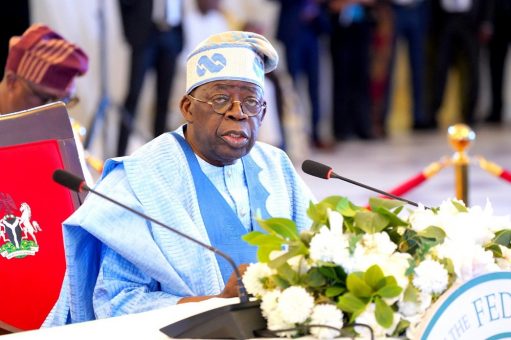
President Bola Tinubu says the Federal Government has waived more than N3.3 trillion in fuel taxes and duties as part of efforts to ease the impact of rising petrol prices and reduce the cost of living for Nigerians.
The President disclosed this in a series of posts on his official X handle on Sunday, while defending the administration’s economic reforms and its response to the recent increase in fuel prices. He said the tax waivers would complement the decision by Nigerian National Petroleum Company Limited (NNPC) Retail to forgo its profit margin for 30 days, with priority given to public transport operators.
Tinubu also said the government was working towards a proposed ceiling of N1,350 per litre on wholesale petrol supply costs to reduce frequent price fluctuations. He maintained that the temporary intervention was intended to provide immediate relief while preserving the broader framework of petrol market deregulation.
The President acknowledged that rising fuel prices had placed considerable pressure on households and businesses. However, he argued that investments in compressed natural gas (CNG) and electric-powered transportation were beginning to reduce transport costs in some parts of the country.
President Highlights Lower Transport Fares
To illustrate the impact of alternative-energy transportation, Tinubu cited the experience of commuters and commercial transport operators who reported savings from CNG and electric-powered vehicles.
He mentioned Blessing, whose journey from Masaka to Berger now costs N500, compared with the previous fare of N1,500. The reduction represents a saving of N1,000, or approximately 67 per cent, per trip.
The President also cited Ada and Abigail, who said their transport fares between Enugu and Nsukka had fallen from N4,000 to N1,600, saving them N2,400 per journey, equivalent to 60 per cent.
Tinubu further referred to Kabir, a commercial taxi driver who said spending N10,000 on CNG enabled him to complete three additional return trips compared with colleagues operating petrol-powered vehicles. According to the President, the driver had resolved not to return to petrol-powered transportation because of the savings.
In Borno State, Tinubu said some commuters paid as little as N50 per trip on government-supported CNG and electric-powered vehicles.
He said lower operating costs for transport operators should translate into more affordable fares for passengers, allowing households to retain more money for food, bills and other essential needs.
The President, however, acknowledged that the benefits were not yet available to everyone. He promised to expand the programme in partnership with state governments and private investors, following requests from Nigerians for more buses and improved access to affordable transportation.
Over 120,000 Vehicles Converted to CNG
Tinubu said the administration was expanding the infrastructure needed to make alternative-energy transportation more accessible nationwide.
According to him, more than 400 certified vehicle conversion centres had been established across the country, while over 120,000 vehicles had been converted from petrol to CNG.
He added that more than 90 CNG refuelling stations were available nationwide, with further investments planned to expand the network.
The President said the removal of petrol subsidy on May 29, 2023, had created difficulties for many households but argued that the government had a responsibility to provide practical alternatives that could lower transportation costs.
Tinubu also outlined the distribution of buses and electric vehicles across several states. Ekiti had received 15 CNG buses, Lagos 20, while Akwa Ibom had 50 buses ready for service.
Katsina had introduced 30 CNG hybrid buses and 200 electric tricycles, while Kano had received 30 CNG buses and five electric buses. Another deployment was scheduled for Edo State.
Ekiti State Governor Biodun Oyebanji inaugurated 15 CNG buses on October 1 and announced plans to reduce fares by 50 per cent on designated routes. Vice-President Kashim Shettima launched CNG hybrid buses and 200 electric tricycles in Katsina on October 4.
Tinubu said the Federal Government would continue working with state governments and private investors to extend affordable transportation services to more communities.
FG Defends Temporary Petrol Discount
The latest intervention followed an announcement by the Minister of Finance and Coordinating Minister of the Economy, Taiwo Oyedele, that NNPC Retail would temporarily sell petrol at cost by forgoing its usual retail profit margin.
Oyedele said the arrangement did not constitute a return to the former petrol subsidy regime because the discount would be funded through the company’s commercial margins rather than direct payments from the Federation Account.
The government is also negotiating a proposed N1,350-per-litre ceiling on wholesale petrol supply costs with refiners and importers. Other measures include accelerating CNG adoption, strengthening domestic fuel supply arrangements and addressing road taxes and levies that contribute to higher transport and logistics costs.
Tinubu maintained that the combination of temporary relief and longer-term investments in alternative transportation would help ease hardship without undermining fiscal sustainability.
He said the government had a responsibility to provide immediate assistance without compromising the country’s financial future, adding that public commitments must be backed by credible and sustainable funding plans.
In an apparent reference to economic proposals being advanced ahead of the 2027 general elections, the President challenged political actors to explain how their promises would be financed and sustained.
Tinubu Cites World Bank Report on Economic Recovery
The President’s defence of the reforms coincided with the release of the World Bank’s October 2026 Nigeria Development Update, titled Beyond the Federal Purse: How Higher Revenues Reshaped State Priorities.
In a statement issued by his Special Adviser on Information and Strategy, Bayo Onanuga, Tinubu welcomed the report, saying it showed that the government’s economic recovery programme was producing results.
According to the report, Nigeria’s economy grew by 4.2 per cent in the first half of 2026, compared with 3.9 per cent during the corresponding period of 2025, despite disruptions associated with the conflict in the Middle East.
The World Bank projected average economic growth of at least 4.4 per cent between 2026 and 2028. It also forecast a gradual decline in poverty if economic growth continued to outpace population growth.
The report indicated that Nigeria had recorded its first stabilisation in the poverty rate since 2019, although sustained reductions would depend on continued economic expansion and the extent to which growth translated into improved household welfare.
Tinubu attributed the progress to petrol subsidy removal, the unification of the foreign exchange market and stronger fiscal discipline. He said the reforms had increased government revenues, helped stabilise the economy and created additional fiscal resources for federal and state governments.
The report also showed that inflation declined from 27.6 per cent in January 2025 to 15.2 per cent in December 2025. However, higher global fuel prices associated with the Middle East conflict had slowed the pace of disinflation. The World Bank projected that inflation could ease to approximately 12 per cent by 2028.
Nigeria’s current account surplus rose to $12 billion, representing about seven per cent of Gross Domestic Product, in the first half of 2026, compared with $8.6 billion in the same period of 2025.
Gross external reserves also increased from $45.5 billion at the end of December 2025 to $53.8 billion by the end of August 2026. Meanwhile, public debt was projected to decline from 40 per cent of GDP in 2025 to 38.1 per cent in 2026.
State Governments Record Higher Revenues
The World Bank report estimated that economic reforms introduced since 2023 contributed to a 69 per cent increase in federation revenues in real terms between 2023 and 2025.
State governments were identified as the biggest beneficiaries of the additional resources, increasing capital expenditure by 151 per cent in real terms during the period. Investments were directed towards economic infrastructure, including roads, transportation, agriculture, energy and housing.
The report found that 29 of the 33 states assessed had shifted spending towards economic infrastructure, while real social expenditure per person increased in all but one of the states covered.
Internally generated revenue also increased in real terms in 31 of the 35 states assessed, while 21 states reduced their debt-to-GDP ratios between 2021 and 2025.
Tinubu urged governors to manage their increased revenues prudently and prioritise projects that improve citizens’ welfare, particularly in healthcare, education and other essential services.
He said targeted cash transfers had reached more than 10 million households and pledged to accelerate CNG deployment, improve agricultural productivity and expand access to affordable healthcare and quality education.
The President also commended the Economic Management Team, led by Oyedele, as well as state governors and other stakeholders, for their cooperation in implementing the reforms.
He reiterated his commitment to sustaining the economic programme while placing greater emphasis on inclusive growth and ensuring that improved economic indicators translated into tangible benefits for households.
Peter Obi Questions Impact of 30-Day Intervention
Meanwhile, the presidential candidate of the Nigeria Democratic Congress (NDC), Peter Obi, questioned whether the Federal Government’s 30-day petrol intervention could meaningfully ease the economic pressures confronting Nigerians.
In a statement on his X handle, the former Anambra State governor said he had delayed commenting on the initiative to allow time to assess its implementation and outcomes.
Obi described the intervention as reactive and questioned the value of a temporary petrol discount that he said amounted to less than five per cent.
He recalled the removal of petrol subsidy on May 29, 2023, arguing that the decision was taken without adequate consultation or a proper assessment of its likely consequences for the economy and household livelihoods.
The opposition politician also criticised the subsequent floating of the naira and tax reforms, which he said had been implemented without sufficient coordination. He further raised concerns about the simultaneous operation of three budgets, questioning the implications for transparency and accountability in public financial management.
According to Obi, the combined effects of these policies had contributed to rising prices, worsening poverty, shrinking economic opportunities, business closures, unemployment, insecurity and widening inequality. He also cited the migration of young Nigerians and declining public well-being as concerns arising from the economic situation.
Obi accused the Tinubu administration of failing to conduct and publish detailed regulatory impact assessments of its policies. He argued that such assessments would help the government evaluate the consequences of its decisions and engage stakeholders and citizens in developing more inclusive economic strategies.
He questioned whether the temporary petrol discount could significantly reduce poverty, unemployment, insecurity and inequality or improve productivity and exports. He also asked whether the initiative was intended to test the possibility of restoring petrol subsidy or was politically motivated ahead of the 2027 general elections.
“Too many questions, no answer!” Obi said, urging the government to explain how the intervention would address the wider economic challenges facing Nigerians.
The debate over the petrol discount comes as the Federal Government defends its reform programme using indicators such as economic growth, higher revenues and improved external reserves, while opposition figures question whether those gains are translating into meaningful reductions in living costs and better living standards for ordinary Nigerians.
SOURCE: THE NATION
