

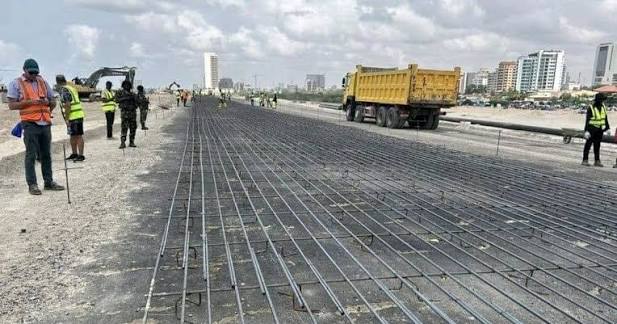
The Federal Government spent N6.47 trillion on strategic infrastructure projects between June 2023 and December 2025, with major highway developments receiving more than half of the allocation.
This is contained in the Federal Government’s Nigeria Reform Scorecard on savings from fuel subsidy removal, titled “The Benefits, Costs and Harm Prevented.”
The Lagos-Calabar Coastal Highway received the largest share among the projects listed, with N2.23 trillion disbursed for its construction.
It was followed by the Sokoto-Badagry Superhighway with N1.11 trillion and the Trans-Sahara Superhighway, which received N489.3 billion.
Together, the three projects accounted for about N3.83 trillion of the N6.47 trillion infrastructure expenditure recorded in the scorecard.
The report said the spending formed part of an additional N30.64 trillion in Federal Government expenditure during the period, following economic reforms introduced by the administration.
Finance Minister and Coordinating Minister of the Economy, Taiwo Oyedele, had said the removal of petrol subsidy and the unification of the foreign exchange market generated N15.8 trillion in additional resources for the Federation between June 2023 and December 2025.
Oyedele explained that the subsidy savings did not appear as a separate item in the Federation Account but were reflected through increased revenue collections, including higher naira receipts from Customs and other agencies following exchange-rate adjustments.
Major Infrastructure Allocations
The Lagos-Calabar Coastal Highway accounted for about 34 per cent of the N6.47 trillion strategic infrastructure expenditure.
Other major allocations included N366 billion for emergency road interventions and N304.2 billion for the Abuja-Kaduna-Kano Road, Section II.
The government also allocated N291.3 billion to the Lekki Deep Sea Port Access Road, N250 billion to the Renewed Hope Smallholder Support Programme and N228.4 billion to the Ilesha-Akure-Benin road section.
The scorecard further listed N124.7 billion for the construction of 1,550 housing units for personnel of the Nigerian Armed Forces and N109.9 billion for Operation Lake Sanity, a multinational security operation.
The Ministry of Finance said the infrastructure spending was intended to tackle long-standing obstacles to investment, productivity and economic expansion.
Lagos-Calabar Highway Attracts Major Funding
The Lagos-Calabar Coastal Highway, one of the administration’s flagship road projects, is designed to run along Nigeria’s southern coastline and connect nine states.
The first 47.47-kilometre section in Lagos has been substantially completed, while construction has continued on a 28-kilometre dual carriageway in Ogun, a 52-kilometre stretch in Ondo and 27 kilometres in Calabar.
Sections in Akwa Ibom and Calabar had also recorded more than 60 per cent completion, while foundation work continued along the Ondo corridor and concrete paving was underway on the Ogun section.
The project has generated debate over its cost, funding arrangement and the pace of government disbursements.
The N2.23 trillion allocated to the highway was more than twice the N1.11 trillion spent on the Sokoto-Badagry Superhighway and over four times the N489.3 billion allocated to the Trans-Sahara Superhighway.
Wage and Debt Costs Dominate Additional Spending
The N6.47 trillion infrastructure expenditure was part of a broader N30.64 trillion increase in Federal Government spending during the 30-month period.
Wage adjustments represented the largest component, accounting for N9.39 trillion.
Another N9.37 trillion was attributed to the effect of foreign exchange movements on external debt servicing, reflecting the impact of the naira’s depreciation on public finances.
Monetary policy effects on domestic debt servicing accounted for N1.24 trillion.
The government also spent N424 billion on social welfare transfers, while N419 billion went to interventions involving the FCT, Ecological Fund and Natural Resources.
A further N201 billion was linked to the increased naira cost of foreign obligations.
The scorecard put incremental borrowing during the period at N11.85 trillion, underscoring the financial pressure on the Federal Government.
The N9.39 trillion spent on wage adjustments was N2.92 trillion, or about 45.1 per cent, higher than the strategic infrastructure expenditure.
Similarly, the N9.37 trillion attributed to the foreign exchange impact on external debt service exceeded infrastructure spending by N2.90 trillion, representing about 44.8 per cent.
